


Gang-Tool Lathe Cycle Time: Why QPR-36L Wins on Small Parts
On a 3–5 second part, tool change dominates the cycle. QPR-36L replaces turret indexing with an X-axis traverse: Φ36 mm bar capacity, 5000 rpm, 28 N·m, 25 m/min rapids, X 650 / Z 230 mm. That is where 15–30% of the cycle goes away.
Where does the time actually go?
A turret machine spends 0.4–0.8 s per index lifting, rotating and clamping. A gang-tool lathe moves in X only, and the next tool is already at height. Across eight tools per part, the difference is the entire cycle advantage.
The trade-off is tool count and stroke: gang machines carry fewer tools and shorter Z travel, so they suit short, feature-dense parts rather than long shafts.
| Item | QPR-36L | QPR-46L |
|---|---|---|
| Bar capacity (mm) | Φ36 | Φ46 |
| Spindle bore (mm) | Φ45 | Φ56 |
| Max swing (mm) | Φ400 | Φ420 |
| Tool plate (mm) | Φ100 | Φ126 |
| Spindle speed (rpm) | 5000 | 4500 |
| Spindle power / torque | 5.5 kW / 28 N·m | 7.5 kW / 35 N·m |
| X/Z travel (mm) | 650/230 | 900/280 |
| Guideway (mm) | 25 ball | 30 ball |
| Tool holder (mm) | 16×16 | 20×20 |
| Machine weight (kg) | about 2200 | about 2500 |
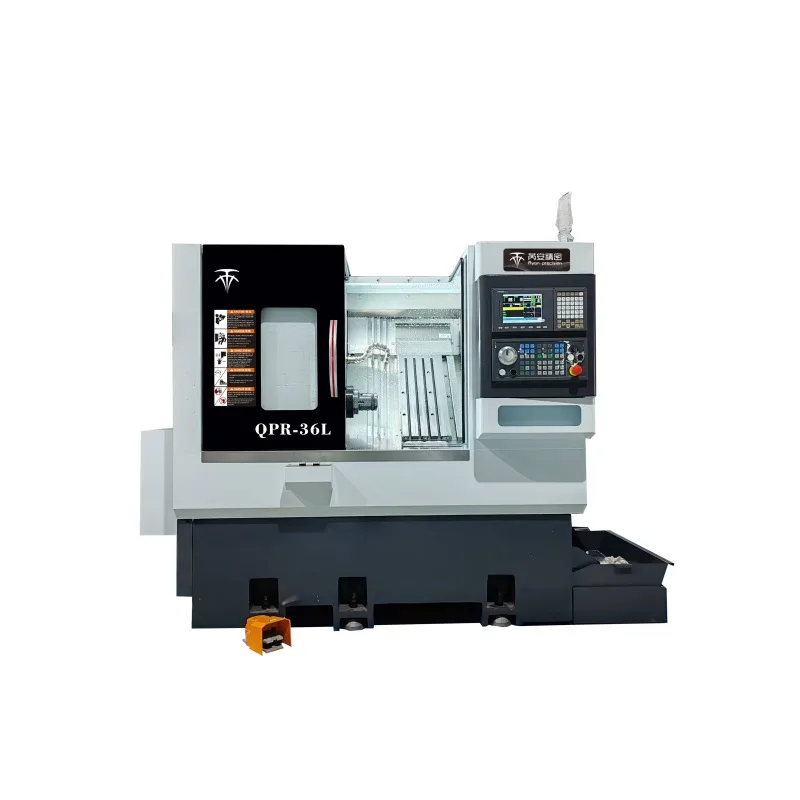
QPR-36L gang-tool lathe
Which part families fit a Φ36 bar?
Fasteners, hydraulic fittings, bushings, sensor housings, pneumatic fittings and small shafts. If the drawing starts at Φ40 bar or needs 35 N·m for a deep bore, move to QPR-46L rather than derating the cycle.
Tool layout that keeps the cycle short
Place rough turning, finish turning and cut-off in three zones along the plate. Keep the most-used tools at the ends nearest the cut-off position so the longest travel happens once per part, not once per tool.
Automation and acceptance
A bar feeder plus parts catcher turns the machine into a cell. At acceptance, measure spindle runout, X/Z repeatability, tool height and a test part: 0.008 mm roundness, 0.01 mm face flatness.
Frequently Asked Questions
Q1: Why is a gang-tool lathe faster than a turret lathe on small parts?
A: Tool change on a gang-tool lathe is an X-axis traverse, not a turret index plus clamp. With 25 m/min rapids and 650 mm X travel, non-cutting time per part drops by 15–30% compared with a same-size turret machine.
Q2: What is the bar capacity of QPR-36L?
A: Bar through the spindle Φ36 mm with a Φ45 mm spindle bore, 5000 rpm, 5.5 kW, 28 N·m, A2-4 nose and 5-inch chuck.
Q3: How do QPR-36L and QPR-46L split?
A: By bar first: up to Φ36 mm take 36L, Φ36–46 mm take 46L. Then by tooling: 16×16 tool holders on 36L versus 20×20 on 46L, and 28 N·m versus 35 N·m torque.
Q4: What depth of cut can 28 N·m support?
A: On 1045 steel, 1.5 mm depth of cut at 0.08–0.12 mm/rev is comfortable. Copper and aluminium run 2.5 mm at 0.15 mm/rev. Exceeding rated torque triggers spindle slowdown and lengthens the cycle.
Q5: How many tools can be arranged on the bed?
A: The tool plate is Φ100 mm with 16×16 square holders and a Φ20 mm boring holder. Arrange rough, finish and cut-off in three zones; filling every slot leaves no room for a second finishing pass.
Q6: Can QPR-36L run unattended?
A: Yes, with a bar feeder and a parts catcher. The bar passes through the tail of the spindle, so leave at least 1.2 m behind the machine for a 3 m bar magazine.
Q7: What does the 2200 kg frame buy?
A: Mass plus 25 mm ball guideways control vibration during high-speed short strokes. The machine is about 2200 kg and occupies 1750×1250×1550 mm, which suits a cell layout rather than a heavy foundation line.
Q8: What is checked at acceptance?
A: Spindle radial and face runout, X/Z repeatability, tool-plate height against spindle center, then a test part with OD, face and bore: 0.008 mm roundness and 0.01 mm face flatness are the pass values.
Related pages on this site
QPR-36L gang-tool lathe | QPR-46L gang-tool lathe | CK-6140 flat-bed lathe | QPR-46L vs QPR-36L
Dongguan Ruian Precision Machinery Co., Ltd.
Tel: +86 13929438020
Email: Vince@ruiancnc.com
Address: 1/F, Building 7, No. 8 TianKeng Gaoxin Road, Hengli Town, Dongguan, Guangdong, China
Website: ruiancnc.cn
Further reading
VMC-850L rigidity | Spindle bore and real bar capacity | HMS-320MY compact turn-mill | HMS-750MY Y-axis
Next:
None
Related News
- -HMS-750 at 740 mm: Which Parts Fit, 10 Answers on Φ52 Bar Work
2026-11-24 - -CK-6140 vs CK-6150B: Φ66 and Φ82 Spindle Bores in 10 Questions
2026-11-24 - -Swiss-Type 125 vs 205: Φ12 and Φ20 Bar Boundaries in 10 Answers
2026-11-24 - -Turn-Mill One Setup vs Lathe + Machining Center: Where Accuracy Breaks
2026-11-23 - -VMC-850L Acceptance: ±0.005 mm Positioning and 24T Tool Sequencing
2026-11-23 - -Gang-Tool Lathe Cycle Time: Why QPR-36L Wins on Small Parts
2026-11-23 - -Spindle Bore Φ56, Φ66 or Φ82: How Thick a Bar Can You Actually Run?
2026-11-22 - -HMS-550MYS vs HMS-550MY: Sub-Spindle or Tailstock?
2026-11-22 - -HMS-320MY Compact Turn-Mill: Which Parts Actually Fit?
2026-11-22 - -What Does a ±50 mm Y-Axis Cover? HMS-750MY Turn-Mill Machine Explained
2026-11-21
