


Swiss-Type 125 vs 205: Φ12 and Φ20 Bar Boundaries in 10 Answers
Short answer: parts whose maximum OD stays inside Φ12 belong on model 125. Parts that reach Φ20, or start from Φ16–Φ20 blanks, belong on model 205. Both are 2,600 kg twin-spindle machines; the real dividing line is bar range and back-working capacity, not price.
The two quotations usually land close together, which is why buyers default to the larger machine. Running Φ8 needle work on a 205 wastes cycle time and material; running Φ18 work on a 125 is simply out of range. Ten questions below set the line.
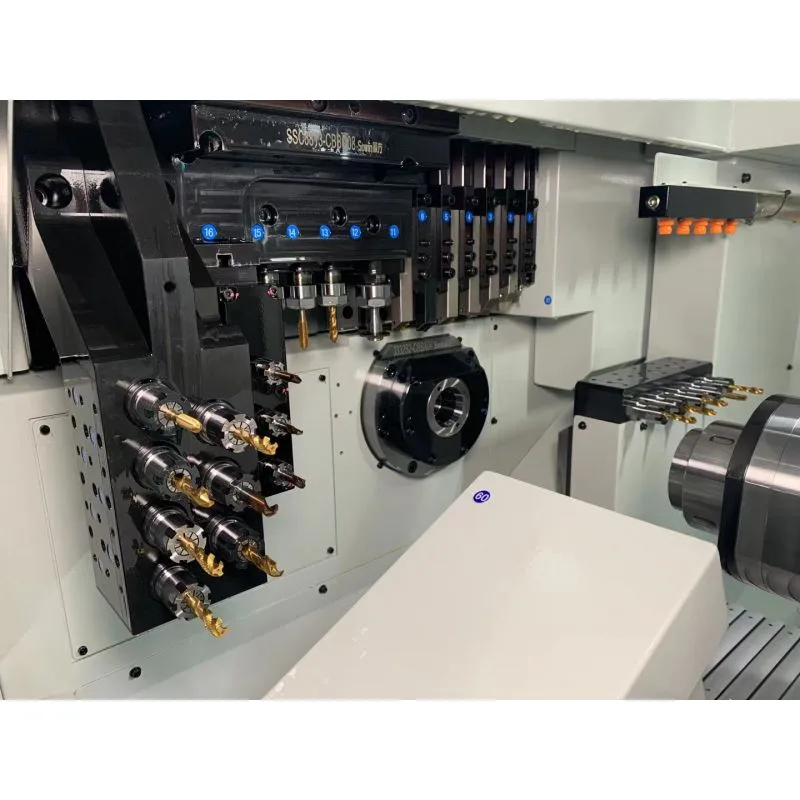
Swiss-type lathe model 125
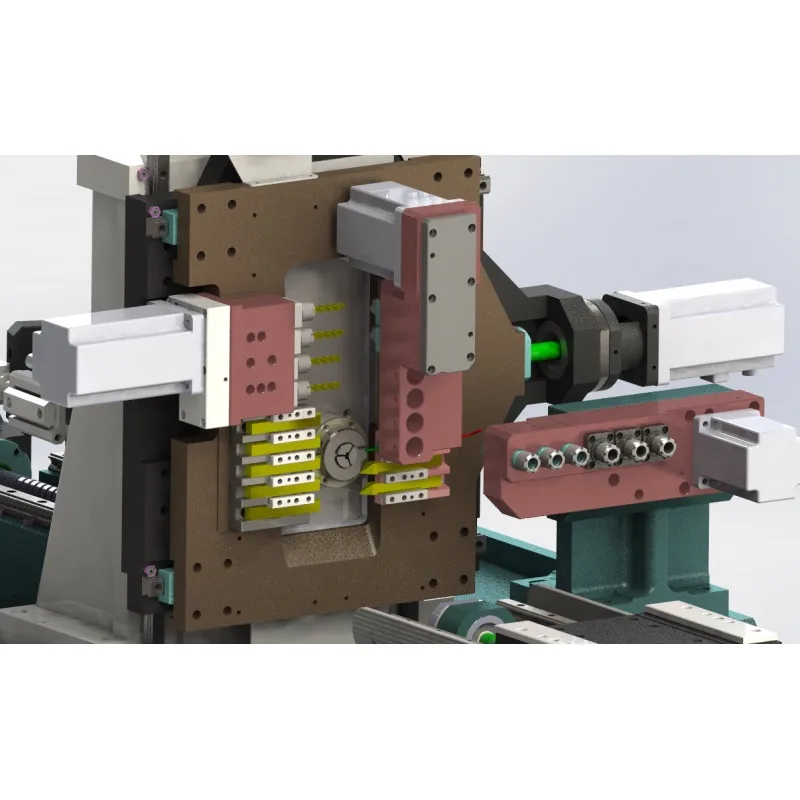
Swiss-type lathe model 205
Model 125 and 205 side by side
| Item | Model 125 | Model 205 |
|---|---|---|
| Main spindle bar range | Φ2–Φ12 mm | Φ3–Φ20 mm |
| Spindle bore | Not published (rated by bar range) | 25 mm |
| Sub-spindle clamping | Φ1–Φ12 mm | Φ20 mm |
| Guided length | 125 mm | 125 mm |
| Non-guided length | 290 mm (option) | About 3 × bar diameter |
| Main spindle power / speed | 3.7 kW / 10,000 rpm | 3.7 kW / 10,000 rpm |
| Sub-spindle power / speed | 5.5 kW / 10,000 rpm | 3.7 kW / 10,000 rpm |
| Machine weight | 2,600 kg | 2,600 kg |
Φ12 and Φ20: one line, two kinds of order
Φ12 is the usual ceiling for micro-precision work: connector pins, probes, micro motor shafts, medical needles, watch arbors. Those parts start from Φ8–Φ12 ground bar, exactly the range of model 125, and 10,000 rpm builds surface speed at small diameters.
Φ20 covers automotive sensor bodies, small hydraulic spools and electronic hardware, usually from Φ16–Φ20 blanks. Model 205 takes them through a 25 mm bore in one pass; a 125 cannot, and no parameter change fixes that.
Sub-spindle power: the 125 works harder at the back
Both main spindles are 3.7 kW / 10,000 rpm. The difference is the sub-spindle: 5.5 kW on model 125 against 3.7 kW on model 205. If the back side drills, mills or faces with real stock removal, the 125 holds up better; for chamfering and deburring the difference is small.
Guided or non-guided: decide on part length and remnant
Guided length is 125 mm on both machines, with the cut right at the bushing, which is what gives slender parts their concentricity and finish. Non-guided gives 290 mm on the 125 (option) and about three bar diameters on the 205, with a shorter remnant and better material yield on short, high-volume parts.
Model 125 also offers a 190 mm fixed guide. Choose by length-to-diameter ratio and remnant cost, not by default.
Tooling and cycle time on micro parts
Model 125 carries 2 ER16 live tools plus 4 ER16 fixed tools on the main face, and 3 live plus 3 fixed drill holders on the sub face, live heads at 5,000 rpm. On parts with end-face milling and eccentric drilling, those stations are what allow one clamping to finish the part.
Both at 2,600 kg: swapping models needs no new foundation
At about 2,600 kg each, footprint and anchor layout are close. A shop that starts on a 125 and later sees parts grow can move to a 205 without rebuilding the base or the loader — a practical benefit of keeping the family together.
Why slender parts need the Swiss-type layout
In a Swiss-type the cut stays next to the bushing while the bar advances, so overhang is constant and a Φ5 shaft comes out straight. On a chuck-type lathe the part is held at one end and overhangs, so the same shaft tapers and rings. If the part is thin, long and tight, look at Swiss-type first.
Frequently Asked Questions
Q1: What bar range does each machine take?
A: Model 125: spindle bar Φ2–Φ12 mm, sub-spindle Φ1–Φ12 mm. Model 205: spindle bar Φ3–Φ20 mm, 25 mm bore, back spindle up to Φ20 mm.
Q2: Φ12 or Φ20 — how is the order split?
A: Parts whose maximum OD stays within Φ12 (connectors, probes, micro shafts, medical needles) go on 125. Parts up to Φ20, or blanks already Φ16–Φ20, go on 205. Pushing Φ18 work onto 125 is out of range, not a parameter problem.
Q3: Are the spindle powers the same?
A: No. Model 125: 3.7 kW / 10,000 rpm main, 5.5 kW / 10,000 rpm sub. Model 205: 3.7 kW main and 3.7 kW sub, both 10,000 rpm. The 125 has the stronger back-working spindle.
Q4: Guided or non-guided bushing?
A: Both give 125 mm guided length. Model 125 offers 290 mm non-guided as an option; model 205 gives about three times bar diameter. Long slender parts want the guide bushing; short parts with expensive material want non-guided to cut the remnant.
Q5: How many bushing configurations does 125 have?
A: Three: sliding guide 125 mm, non-guided 290 mm, fixed guide 190 mm — selected by part length and accuracy requirement.
Q6: What is the tooling on model 125?
A: Main spindle face: 2 × ER16 live plus 4 × ER16 fixed, live heads at 5,000 rpm. Sub-spindle face: 3 × ER16 live plus 3 × ER16 fixed drill holders, sub live head 1 kW.
Q7: Do both weigh the same?
A: Both are about 2,600 kg, with similar footprint and foundation, so a shop can move from one to the other without rebuilding the base.
Q8: Typical parts?
A: 125: connector pins, micro motor shafts, medical needles, watch parts. 205: automotive sensor bodies, small hydraulic spools, electronic hardware, Φ16–Φ20 shafts.
Q9: Why Swiss-type rather than a turret lathe for small bars?
A: The cut sits next to the guide bushing while the bar advances, so the overhang stays constant. A chuck-type lathe overhangs the part and a Φ5 shaft comes out tapered and chatty.
Q10: How is delivery and acceptance handled?
A: Standard models ship in 5–20 days; custom builds on request. At acceptance, run your own part continuously and measure OD and concentricity first against last.
Related pages
CK-6140 flat-bed lathe | CK-6150B flat-bed lathe | HMS-750 long-bed turret lathe | Swiss-type 125 | Swiss-type 205
Dongguan Ruian Precision Machinery Co., Ltd.
Tel: +86 13929438020
Email: Vince@ruiancnc.com
Address: 1/F, Building 7, No. 8 TianKeng Gaoxin Road, Hengli Town, Dongguan, Guangdong, China
Website: ruiancnc.cn
Swiss-type vs gang-tool: how to choose | HMS-750 product page | CK-6150B product page | CK-6140 product page
Next:
None
Related News
- -HMS-750 at 740 mm: Which Parts Fit, 10 Answers on Φ52 Bar Work
2026-11-24 - -CK-6140 vs CK-6150B: Φ66 and Φ82 Spindle Bores in 10 Questions
2026-11-24 - -Swiss-Type 125 vs 205: Φ12 and Φ20 Bar Boundaries in 10 Answers
2026-11-24 - -Turn-Mill One Setup vs Lathe + Machining Center: Where Accuracy Breaks
2026-11-23 - -VMC-850L Acceptance: ±0.005 mm Positioning and 24T Tool Sequencing
2026-11-23 - -Gang-Tool Lathe Cycle Time: Why QPR-36L Wins on Small Parts
2026-11-23 - -Spindle Bore Φ56, Φ66 or Φ82: How Thick a Bar Can You Actually Run?
2026-11-22 - -HMS-550MYS vs HMS-550MY: Sub-Spindle or Tailstock?
2026-11-22 - -HMS-320MY Compact Turn-Mill: Which Parts Actually Fit?
2026-11-22 - -What Does a ±50 mm Y-Axis Cover? HMS-750MY Turn-Mill Machine Explained
2026-11-21
