


CK-6140 vs CK-6150B: Φ66 and Φ82 Spindle Bores in 10 Questions
Short answer: bars up to Φ50 class, small discs and non-ferrous work go on CK-6140. Bars at Φ60–Φ65 class, flanges near Φ500 mm or shafts up to a metre go on CK-6150B. The line between them is bore, chuck and speed range — not overall size.
Buyers often bring a drawing and ask why two flat-bed lathes with a 100 mm swing difference carry such different prices. Here are the ten questions we answer most often; every figure is taken from the published specification tables on this site.
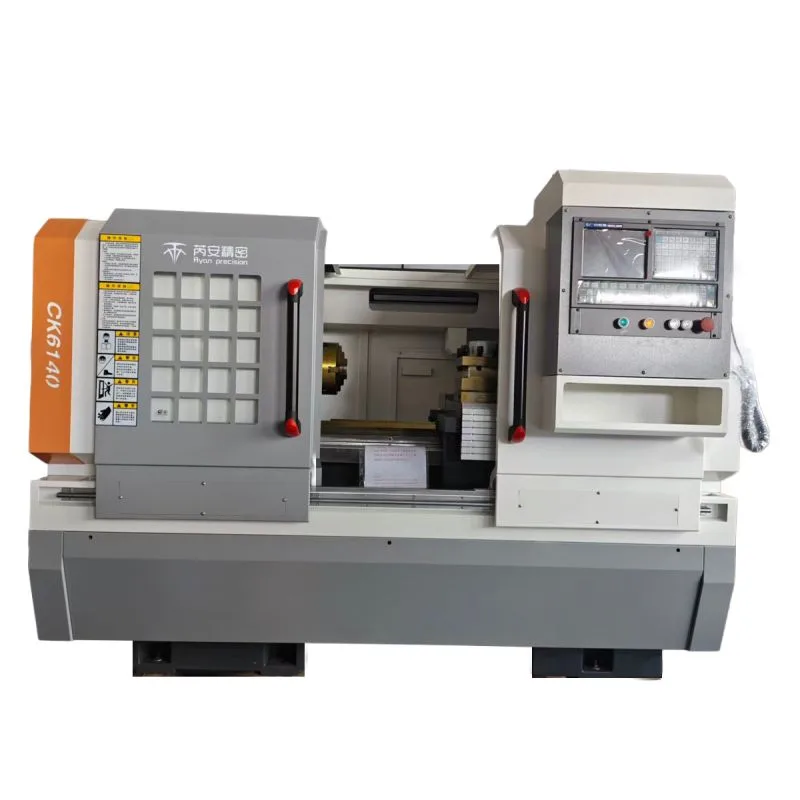
CK-6140 flat-bed lathe
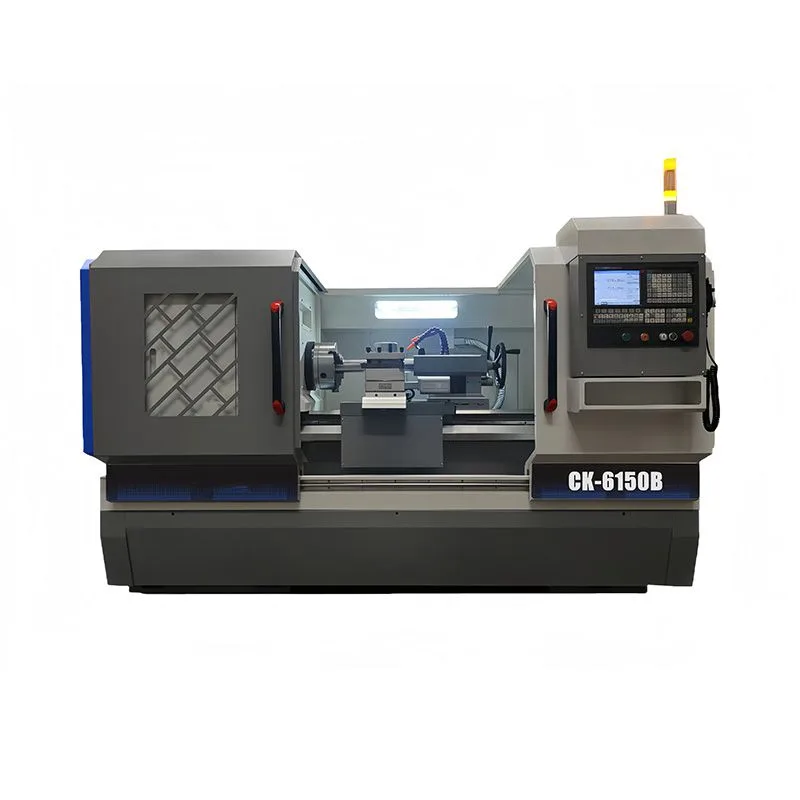
CK-6150B flat-bed lathe
Where do the two machines actually differ?
Put them side by side and the differences cluster in swing, spindle nose, bore and speed range. Tailstock and centre distance scale with the bigger frame.
| Item | CK-6140 | CK-6150B |
|---|---|---|
| Swing over bed | Φ420 mm | Φ500 mm |
| Swing over cross slide | Φ210 mm | Φ290 mm |
| Spindle nose | A2-6 | A2-8 |
| Spindle bore | Φ66 mm | Φ82 mm |
| Spindle speed | 50–2,000 rpm, servo stepless | 65–1,600 rpm, 3 geared steps |
| Between centres | 750 mm | 1,000 mm |
| Tailstock sleeve / stroke / taper | Φ65 mm / 150 mm / M4 | Φ75 mm / 150 mm / M5 |
Φ66 or Φ82: can the bar run through the spindle?
A bore is not a guarantee that a bar of that size can be machined. The bar needs clamping length inside the collet and clearance to rotate, so practical bar stock sits one size below the bore: Φ66 corresponds to Φ50-class bars, Φ82 covers Φ60–Φ65 class. If the order says “Φ60 bar, bar-fed, one setup”, CK-6140 cannot do it.
Conversely, for Φ30–Φ45 shafts, bolts and fittings, Φ66 is already enough. Paying for Φ82 buys no throughput and simply lands on unit cost.
Speed range: wide stepless versus low-end torque
CK-6140 gives 50–2,000 rpm stepless, which lets you drop low for stainless, non-ferrous and thin-wall parts. CK-6150B gives 65–1,600 rpm in three geared steps, so the low step carries more torque for heavy cuts on large diameters.
A quick rule on the shop floor: big stock removal, hard material, heavy single pieces — the geared machine. Small stock removal, fast cycles, softer material — the stepless machine.
Long shafts and discs land on different machines
Long shafts are decided by centre distance and tailstock. CK-6150B gives 1,000 mm and an M5 sleeve at Φ75 mm, so anything past 750 mm — or needing a steady for multi-point support — belongs there. Discs are decided by swing: Φ500 mm over bed and Φ290 mm over the cross slide take larger flanges and hubs.
How the machines are accepted
Both are laser-checked per machine to ±0.005 mm positioning and ±0.003 mm repeat positioning, and the record ships with the machine. On arrival, cut ten of your own parts and compare the first against the last — that tells you more than a certificate.
Frequently Asked Questions
Q1: What is the spindle bore of CK-6140?
A: Φ66 mm, with an A2-6 spindle nose, Φ420 mm swing over bed, Φ210 mm over cross slide and 750 mm between centres.
Q2: How much bigger is CK-6150B?
A: Three steps up: Φ500 mm swing, Φ82 mm bore and an A2-8 nose. Centre distance grows from 750 mm to 1,000 mm.
Q3: Φ66 and Φ82 — what bar size can actually pass?
A: A bar needs clamping length and rotating clearance, so practical bar stock sits one size below the bore. Φ66 handles Φ50-class bars; Φ82 covers Φ60–Φ65-class bars. Confirm with the chuck or collet you plan to use.
Q4: How do the spindle speeds differ?
A: CK-6140 runs 50–2,000 rpm infinitely variable on a servo drive. CK-6150B runs 65–1,600 rpm in three geared steps with servo variation inside each step — wider range against more low-end torque.
Q5: Which one for long shafts?
A: CK-6150B, with 1,000 mm between centres and a Φ75 mm sleeve at M5 taper. CK-6140 has a Φ65 mm sleeve at M4 and 750 mm centres, fine for short shafts only.
Q6: Which one for discs and flanges?
A: Swing decides it. CK-6150B takes bigger flanges at Φ500 mm swing and Φ290 mm over the cross slide. Below Φ400 mm, CK-6140 is the cheaper machine.
Q7: Do both have a tailstock?
A: Yes. CK-6140: Φ65 mm sleeve, 150 mm stroke, M4. CK-6150B: Φ75 mm sleeve, 150 mm stroke, M5.
Q8: Flat bed or slant bed?
A: Flat bed wins on rigidity, heavy cuts and long shafts. Slant bed wins on chip evacuation and operator access for small, fast-cycle parts.
Q9: How are the two verified on arrival?
A: Positioning ±0.005 mm and repeat positioning ±0.003 mm, measured per machine with laser interferometry. Then cut ten of your own parts and compare first against last.
Related pages
CK-6140 flat-bed lathe | CK-6150B flat-bed lathe | HMS-750 long-bed turret lathe | Swiss-type 125 | Swiss-type 205
Dongguan Ruian Precision Machinery Co., Ltd.
Tel: +86 13929438020
Email: Vince@ruiancnc.com
Address: 1/F, Building 7, No. 8 TianKeng Gaoxin Road, Hengli Town, Dongguan, Guangdong, China
Website: ruiancnc.cn
Swiss-type vs gang-tool: how to choose | HMS-750 product page | CK-6150B product page | CK-6140 product page
Next:
None
Related News
- -HMS-750 at 740 mm: Which Parts Fit, 10 Answers on Φ52 Bar Work
2026-11-24 - -CK-6140 vs CK-6150B: Φ66 and Φ82 Spindle Bores in 10 Questions
2026-11-24 - -Swiss-Type 125 vs 205: Φ12 and Φ20 Bar Boundaries in 10 Answers
2026-11-24 - -Turn-Mill One Setup vs Lathe + Machining Center: Where Accuracy Breaks
2026-11-23 - -VMC-850L Acceptance: ±0.005 mm Positioning and 24T Tool Sequencing
2026-11-23 - -Gang-Tool Lathe Cycle Time: Why QPR-36L Wins on Small Parts
2026-11-23 - -Spindle Bore Φ56, Φ66 or Φ82: How Thick a Bar Can You Actually Run?
2026-11-22 - -HMS-550MYS vs HMS-550MY: Sub-Spindle or Tailstock?
2026-11-22 - -HMS-320MY Compact Turn-Mill: Which Parts Actually Fit?
2026-11-22 - -What Does a ±50 mm Y-Axis Cover? HMS-750MY Turn-Mill Machine Explained
2026-11-21
