


HMS-1000MY: What Parts Suit a Φ630/950 mm Turning Center?
HMS-1000MY is for large diameter, long shafts and front-side operations: up to Φ580 mm turning diameter, 700–900 mm typical length, and Φ72 mm bar. Beyond 950 mm, or when back-side work is required, move to 750MY or 750MYS instead of forcing this machine.
HMS-1000MY has a Φ630 mm swing, 950 mm maximum turning length, Φ72 mm bar capacity, a BMT55-12T Y-axis live-tool turret and an MT5 tailstock. It is built to finish large parts in one setup, not to make small parts on a big machine.
Data is from the HMS-1000MY product page; the 750-series comparison also follows the original site tables.
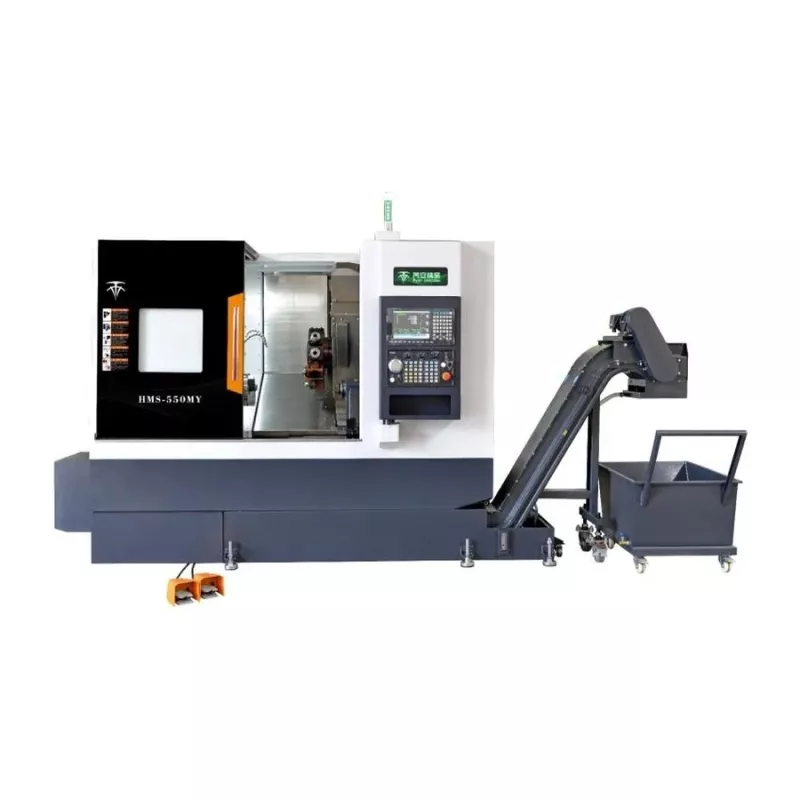
HMS-1000MY large shaft turning center
What are the three limits?
Φ580 mm turning diameter, 950 mm turning length and Φ72 mm bar channel. All three must fit; if any one is outside, change the model before discussing options.
Φ630 mm swing does not mean a Φ630 mm part can be machined. Chuck, turret and tailstock interference must be calculated. Thin-wall large parts also need a deformation check, not just a power check.
Why a 1250 mm tailstock rail for 950 mm parts?
The rail is 300 mm longer than the turning length so the tailstock can retract to the end of the bed when loading, leaving room for large workpieces to be lifted and aligned. A short rail blocks access on large parts.
The quill is Φ100 mm with 120 mm travel, versus Φ80/80 mm on 750MY. Large shafts need more thrust and more travel to absorb thermal growth; a slim quill cannot hold them through continuous cutting.
Use a heavy-duty live centre and check tailstock-to-spindle alignment with a dial indicator after assembly. Misalignment becomes wall-thickness variation in the finished part.
How to use the Φ87 bore and Φ72 bar?
Spindle A2-8, bore Φ87 mm, bar channel Φ72 mm, 2500 rpm maximum, 15 kW / 98 N·m, 10-inch hydraulic collet. The 2500 rpm limit belongs to the large-chuck and large-bore structure; it is not a performance downgrade.
The Φ72 mm channel is normally used with Φ60–Φ68 bar. Near the limit, feeder thrust, clamping repeatability and spindle stiffness matter more. A chuck-only part is not limited by the bar channel; discs and sleeves up to Φ580 mm can be chucked.
Torque is 98 N·m, the same as 750MY, but the chuck and workpiece are larger, so depth of cut must be reduced according to workpiece stiffness. Check deformation before power on thin-wall large parts.
What can Y ±50 mm and BMT55-12T do?
12 stations, 25×25 OD holders, Φ40 ID holders and 3.1 kW / 15 N·m driven tools. Y ±50 mm covers face milling, keyways, flats, off-centre holes and tapping in one setup.
Keyways, flange bolt holes and face oil holes are the main gains: work that used to go to a bed mill or floor borer is completed on the same datum, avoiding a second alignment and an extra lifting operation.
Respect the power limit: 3.1 kW / 15 N·m suits shallow slots, drilling, tapping and light milling. Heavy cutting on large parts belongs to the main spindle, not the driven tool.
How do 1000MY, 750MY and 750MYS differ?
In one line: large diameter, long length and front-side work → 1000MY; medium diameter and long shaft → 750MY; long shaft plus back-side work → 750MYS. The difference is capacity and process combination, not machine grade.
Turning length is 950 / 710 / 635 mm; bar is Φ72 / Φ52 / Φ52; tailstock is 1250/120, 700/80, and none (sub-spindle). Length is the first constraint; select by the longest part.
| Item | HMS-1000MY | HMS-750MY | HMS-750MYS |
|---|---|---|---|
| Max turning length | 950 mm | 710 mm | 635 mm |
| Max turning diameter | Φ580 mm | Φ420 mm | Φ410 mm |
| Bar capacity | Φ72 mm | Φ52 mm | Φ52 mm |
| Spindle nose / bore | A2-8 / Φ87 | A2-6 / Φ65 | A2-6 / Φ65 |
| Max spindle speed | 2500 rpm | 4000 rpm | 4000 rpm |
| Z travel | 1120 mm | 800 mm | 800 mm |
| Tailstock rail / quill | 1250 / 120 mm | 700 / 80 mm | None (sub-spindle) |
| Machine weight | 7000 kg | 4800 kg | 5000 kg |
| Best fit | Large diameter, long shaft | Medium shaft, front side | Long shaft plus back side |
What does 7000 kg and a 45 mm guide support?
X 370 mm, Z 1120 mm and Y ±50 mm all use 45 mm roller linear guides; X/Z servos are 3.9 kW / 18.6 N·m and Y is 2.4 kW / 11.5 N·m. Long travel and high inertia need one class more servo power than 750MY.
The load path on a large shaft is chuck–workpiece–tailstock. Guide stiffness, bed mass and tailstock stiffness together determine mid-span deflection; 7000 kg and the 1250 mm rail are the two most tangible items in that chain.
Accuracy is not a slogan: each machine is checked with a Renishaw laser interferometer for positioning and repeatability and a ballbar for circular interpolation. Use the random accuracy record as the final value.
What should be confirmed before quoting?
Provide the part drawing, maximum diameter and length, piece weight, blank type, turning/milling/drilling/tapping operations, target cycle time, shop door height, crane capacity, foundation and chip-conveyor space.
The machine occupies about 4000×2200×2300 mm including the right chip conveyor. Lift by the marked points, use a spreader beam for the workpiece, and retract the tailstock before loading.
For export, state 380 V/50 Hz or 60 Hz. Confirm the bar feeder, chip conveyor, steady rest and tool-holder list together.
Frequently Asked Questions
Q1: What is the largest part HMS-1000MY can machine?
A: The page states Φ580 mm turning diameter, 950 mm turning length and Φ72 mm bar. Swing is Φ630 mm, but chuck, turret and tailstock interference must be checked.
Q2: Is 950 mm a hard limit?
A: Yes. Do not force a longer shaft through this machine; if the tailstock cannot reach, the part is unsupported. Use 750MY or a larger model for longer work.
Q3: Can Φ72 mm bar be fed continuously?
A: The channel is nominally Φ72 mm; Φ60–Φ68 is common. Near the limit, feeder thrust, clamping repeatability and spindle stiffness must be confirmed with a trial.
Q4: What can Y ±50 mm mill?
A: Faces, keyways, flats, off-centre holes and tapping. The 3.1 kW / 15 N·m driven tool suits shallow slots and light milling; heavy cutting stays with the main spindle.
Q5: How to choose between 1000MY and 750MY?
A: Check length and diameter first: 950 mm/Φ580 → 1000MY; 710 mm/Φ420 → 750MY. Only lengths between 710 and 950 mm call for the 1000MY.
Q6: How to choose between 1000MY and 750MYS?
A: Need back-side work → 750MYS with sub-spindle and 635 mm; front side only and long shaft → 1000MY with 950 mm and tailstock. A sub-spindle is not automatically better.
Q7: What shop requirements does a 7000 kg machine have?
A: Confirm door height, crane capacity, foundation and chip space. The machine is about 4000×2200×2300 mm including the right chip conveyor; use a spreader beam for large parts.
Q8: How are accuracy and lead time confirmed?
A: Positioning and repeatability follow the random accuracy record; the factory checks with a laser interferometer and ballbar. Standard machines take 5–20 days; specials and feeders follow the order.
Contact Us
Phone: +86 13929438020
Email: Vince@ruiancnc.com
Address: No. 8 Gaoxin Road, Tiankeng, Hengli, Dongguan, Building 7, 1st Floor
Website: ruiancnc.com
Further reading: HMS-1000MY product page; HMS-750MY product page; HMS-750MYS product page; HMS-550MYS sub-spindle; BMT55 vs VDI tool holders; Spindle bore Φ52/Φ66/Φ82;
Next:
None
Related News
- -QPR-46L vs QPR-36L: How to Choose a Gang-Tool Lathe
2026-11-28 - -HMS-1000MY: What Parts Suit a Φ630/950 mm Turning Center?
2026-11-28 - -HMS-550MYS: How to Use the Sub-Spindle (435 mm, Φ46)
2026-11-28 - -BMT55 vs VDI Live Toolholders: Interface, Clamping, Changeover
2026-11-27 - -Spindle Bore Φ52, Φ66, Φ82: How Large a Bar Can You Actually Run?
2026-11-27 - -Why Gang-Tool Lathes Win on Small Parts: QPR-36L vs HMS-750 Cycle Time
2026-11-27 - -HMS-750 at 740 mm: Which Parts Fit, 10 Answers on Φ52 Bar Work
2026-11-24 - -CK-6140 vs CK-6150B: Φ66 and Φ82 Spindle Bores in 10 Questions
2026-11-24 - -Swiss-Type 125 vs 205: Φ12 and Φ20 Bar Boundaries in 10 Answers
2026-11-24 - -Gang-Tool Lathe Cycle Time: Why QPR-36L Wins on Small Parts
2026-11-23
