


HMS-550MYS: How to Use the Sub-Spindle (435 mm, Φ46)
HMS-550MYS suits parts with work on both sides, up to 435 mm long and in a stable batch: the main spindle turns the front, the sub-spindle picks off the part and completes the back. For front-side work only, choose 550MY; for longer parts, choose 750MYS. Do not use a sub-spindle to bridge length.
HMS-550MYS has a Φ580 mm swing, 435 mm turning length, main spindle A2-6 with Φ65 mm bore and Φ52 mm bar, sub-spindle A2-5 with Φ56 mm bore and Φ46 mm bar, and a BMT55-12T Y-axis live-tool turret.
Its value is not an extra spindle; it is moving the back-side operation onto the same datum. Data comes from the HMS-550MYS product page; the 550MY comparison follows the original site table.
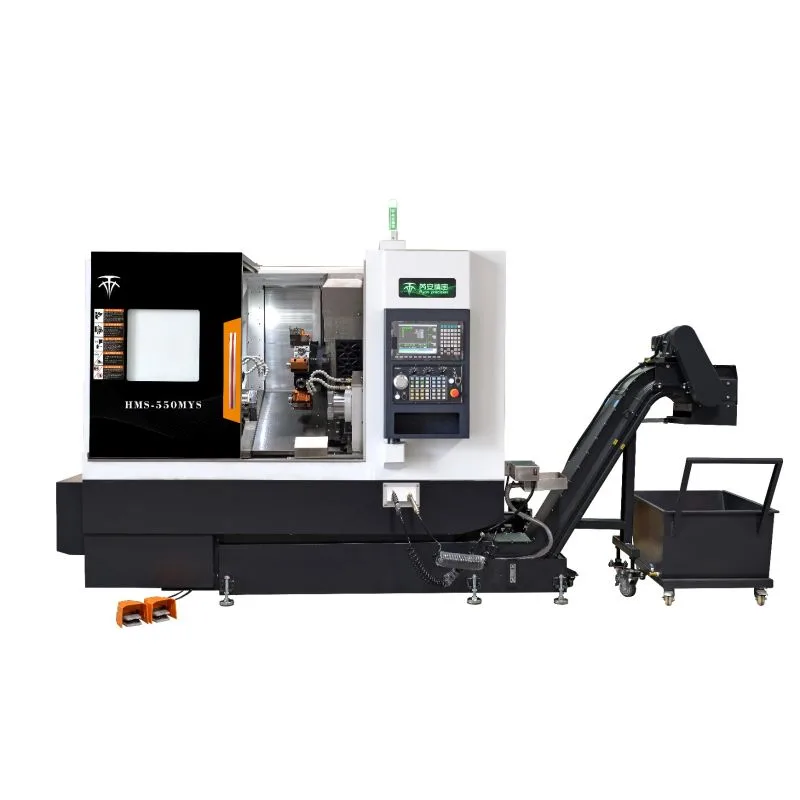
HMS-550MYS dual-spindle turning center
A sub-spindle is not universal: check the back-side operation first
The only criterion is whether the back side has a real operation. Chamfering, boring, grooving, tapping or face milling on the back, in a stable batch, makes a dual-spindle machine the right choice. If the back only needs deburring, a single-spindle machine plus a dedicated operation is cheaper.
Typical parts: hydraulic valve spools and bodies, flanges and end caps, small transmission shafts and pipe fittings. The common factor is two operations on one datum; moving to a second machine means re-alignment.
Where does 435 mm come from? The sub-spindle takes Z space
The distance between the two spindle chuck faces is 40–440 mm. Part length plus clamping at both ends must fall in this range for the sub-spindle to pick off. That is how the 435 mm maximum turning length is set.
550MY is 510 mm with a tailstock; 550MYS is 435 mm because the sub-spindle replaces the tailstock, 75 mm shorter. A dual-spindle is not automatically better: long shafts still need the tailstock version.
Above 435 mm the sub-spindle cannot reach and there is no tailstock, so this machine cannot do the part. Move to 750MY for a long shaft, or 750MYS for a long shaft plus back-side work.
Φ52 main bar and Φ46 sub-spindle bar
Main spindle bore Φ65 mm, bar capacity Φ52 mm; sub-spindle bore Φ56 mm, bar capacity Φ46 mm. Bar stock passes through the main spindle only; the sub-spindle does not feed bar.
Φ52 mm is the draw-bar inside diameter, not the spindle bore. A chuck-only disc is not limited by this value; the difference is continuous feeding and cycle time.
Sub-spindle A2-5, 4000 rpm maximum, 57 N·m, 6-inch chuck. Pick-off, back turning, drilling and tapping must match part weight and length.
What can Y ±50 mm and BMT55-12T do?
12 stations, 25×25 OD holders, Φ40 ID holders and 3.1 kW / 15 N·m driven tools. Y ±50 mm covers face milling, keyways, flats, off-centre holes and tapping.
Aluminium, free-machining steel and 45 steel are fine for shallow slots and holes; a Φ10 end mill at 3–5 mm depth in aluminium is normal, about 1 mm in 45 steel. Deep cavities in tool steel are outside this machine's scope.
Confirm the turret and holder as a pair: a BMT55 holder will not fit a BMT45 turret. Send the machine model, turret type and holder nameplate together when ordering.
How do 550MYS, 550MY and 750MYS differ?
In one line: back-side work and short parts → 550MYS; front side only and short parts → 550MY; back-side work and longer parts → 750MYS. The difference is length and process combination, not grade.
550MYS 435 mm, 550MY 510 mm, 750MYS 635 mm; sub-spindle Φ46 / none / Φ46; Z2 400 / — / 645; main spindle 11 / 11 / 15 kW; machine 4500 / 4300 / 5000 kg.
| Item | HMS-550MYS | HMS-550MY | HMS-750MYS |
|---|---|---|---|
| Max turning length | 435 mm | 510 mm | 635 mm |
| Max turning diameter | Φ410 mm | Φ420 mm | Φ410 mm |
| Main bar | Φ52 mm | Φ52 mm | Φ52 mm |
| Sub-spindle bar | Φ46 mm | — (tailstock) | Φ46 mm |
| Z travel | 800 mm | 600 mm | 800 mm |
| Z2 travel | 400 mm | — | 645 mm |
| Spindle power / torque | 11 kW / 72 N·m | 11 kW / 72 N·m | 15 kW / 98 N·m |
| Turret | BMT55-12T with Y | BMT55-12T with Y | BMT55-12T with Y |
| Machine weight | 4500 kg | 4300 kg | 5000 kg |
| Best fit | Both sides, stable batch | Front side, medium length | Long shaft plus back side |
Accuracy and 45 mm linear guides
All axes use 45 mm roller guides: X 260 mm, Z 800 mm, Y ±50 mm, Z2 400 mm; rapid X 24, Z 14, Y 10, Z2 24 m/min; X/Z/Y servo 2.4 kW / 11.5 N·m.
The difficult part of a dual-spindle machine is not one axis but the alignment of the two spindles, pick-off synchronisation and Z2 repeatability. Acceptance must check two-spindle coaxiality and face runout.
The catalogue values of ±0.005 mm positioning and ±0.003 mm repeatability must be checked against the random accuracy record; re-check after a collision or chuck change.
Six items to confirm before quoting
Part drawing with front and back operations, maximum length and weight, main bar diameter, back-side operations, batch size and changeover frequency, target cycle time and voltage/frequency.
If the back side has only one chamfer, calculate the payback of the dual-spindle first. With insufficient batch, a single-spindle machine plus a dedicated operation is more economical. For a long shaft with back-side work, see HMS-750MYS.
Frequently Asked Questions
Q1: What parts suit HMS-550MYS best?
A: Small and medium parts with operations on both sides, a stable batch and length up to 435 mm: hydraulic valve spools and bodies, flanges, end caps, small shafts and pipe fittings.
Q2: What is the main difference between 550MYS and 550MY?
A: 550MYS replaces the tailstock with a sub-spindle for back-side work in one setup, 435 mm. 550MY has a tailstock, 510 mm, for front-side work on medium-length parts.
Q3: Why is the dual-spindle machine 75 mm shorter?
A: The sub-spindle occupies Z space; the distance between chuck faces is 40–440 mm. 550MYS is 435 mm, 550MY is 510 mm.
Q4: What bar can the sub-spindle take?
A: Sub-spindle bore Φ56 mm, bar Φ46 mm; main spindle bar Φ52 mm. Bar passes through the main spindle only.
Q5: How to machine a long shaft without a tailstock?
A: The standard 550MYS has no tailstock and cannot do shafts over 435 mm. Use 750MY (710 mm, tailstock) or 750MYS (635 mm, tailstock plus sub-spindle).
Q6: What can Y ±50 mm mill?
A: Faces, keyways, flats, off-centre holes and tapping. The 3.1 kW / 15 N·m driven tool is for shallow slots and light milling; deep cavities in tool steel are out of scope.
Q7: What is checked at acceptance?
A: Positioning and repeatability against the random record, two-spindle coaxiality, face runout, pick-off synchronisation and Z2 repeatability. Re-check after a collision or chuck change.
Q8: What is needed before quoting?
A: Front and back drawings, maximum length and weight, main bar, back-side operations, batch and changeover frequency, target cycle time and export voltage/frequency.
Contact Us
Phone: +86 13929438020
Email: Vince@ruiancnc.com
Address: No. 8 Gaoxin Road, Tiankeng, Hengli, Dongguan, Building 7, 1st Floor
Website: ruiancnc.com
Further reading: HMS-550MYS product page; HMS-550MY product page; HMS-750MYS product page; HMS-1000MY large part guide; QPR-46L vs QPR-36L; Spindle bore Φ52/Φ66/Φ82;
Next:
None
Related News
- -QPR-46L vs QPR-36L: How to Choose a Gang-Tool Lathe
2026-11-28 - -HMS-1000MY: What Parts Suit a Φ630/950 mm Turning Center?
2026-11-28 - -HMS-550MYS: How to Use the Sub-Spindle (435 mm, Φ46)
2026-11-28 - -BMT55 vs VDI Live Toolholders: Interface, Clamping, Changeover
2026-11-27 - -Spindle Bore Φ52, Φ66, Φ82: How Large a Bar Can You Actually Run?
2026-11-27 - -Why Gang-Tool Lathes Win on Small Parts: QPR-36L vs HMS-750 Cycle Time
2026-11-27 - -HMS-750 at 740 mm: Which Parts Fit, 10 Answers on Φ52 Bar Work
2026-11-24 - -CK-6140 vs CK-6150B: Φ66 and Φ82 Spindle Bores in 10 Questions
2026-11-24 - -Swiss-Type 125 vs 205: Φ12 and Φ20 Bar Boundaries in 10 Answers
2026-11-24 - -Gang-Tool Lathe Cycle Time: Why QPR-36L Wins on Small Parts
2026-11-23
