

Swiss-Type 125 in Service: Bushing, Sub-Spindle, 10 Questions
The point of model 125 is not that it is small, it is the bushing: 125 mm guided, 290 mm non-guided and 190 mm fixed decide both concentricity and remnant cost. Φ2–Φ12 mm is a hard boundary — do not force Φ18 work onto it.
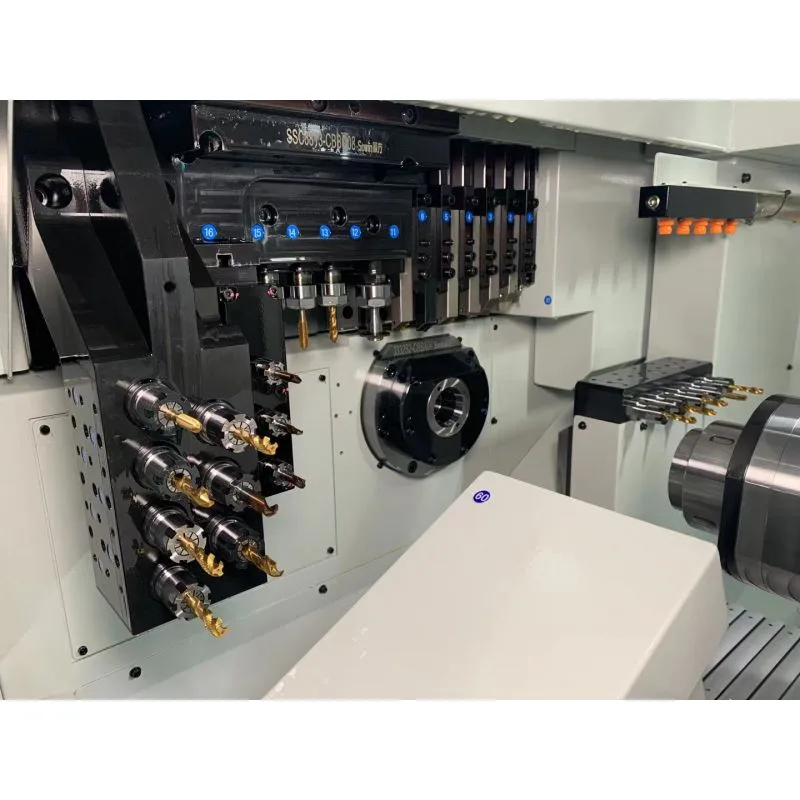
Swiss-type lathe model 125
| Item | Value |
|---|---|
| Main bar range | Φ2–Φ12 mm |
| Sub-spindle | Φ1–Φ12 mm |
| Guided length | 125 mm |
| Non-guided length | 290 mm (option) |
| Main power / speed | 3.7 kW / 10,000 rpm |
| Sub power / speed | 5.5 kW / 10,000 rpm |
| Machine weight | About 2,600 kg |
Q1: What bar does model 125 take?
A: Φ2–Φ12 mm on the main spindle, Φ1–Φ12 mm on the sub-spindle. Anything above Φ12 belongs to model 205 (Φ3–Φ20); it is out of range, not a setting.
Q2: Three bushing options — how to choose?
A: Sliding guide 125 mm, non-guided 290 mm (option), fixed guide 190 mm. Slender parts needing concentricity use a guide; short parts with expensive material use non-guided to cut the remnant.
Q3: Why is the 5.5 kW sub-spindle bigger than the main?
A: Back-side drilling, milling and facing with real stock removal need it. Model 125 runs 5.5 kW / 10,000 rpm at the sub, against 3.7 kW on model 205.
Q4: What tooling is on the faces?
A: Main face: 2 × ER16 live and 4 × ER16 fixed, live heads at 5,000 rpm. Sub face: 3 × ER16 live and 3 × ER16 fixed drill holders, sub live head 1 kW.
Q5: What does 10,000 rpm mean for tiny diameters?
A: A Φ5 part runs about 157 m/min at 10,000 rpm, inside the normal carbide window. With less speed you reduce feed to keep finish, and cycle time grows.
Q6: What does the 290 mm non-guided mode save?
A: Remnant. Guided turning needs clamping allowance and scraps a long bar end; non-guided works on the three-diameter rule and lifts material yield, at some cost in concentricity.
Q7: Is 2,600 kg necessary for micro parts?
A: Yes. Cutting force is small, so machine vibration and thermal drift dominate the error budget; mass and structural rigidity decide consistency on Φ2–Φ5 parts.
Q8: Typical parts?
A: Connector pins, probes, micro motor shafts, medical needles, watch parts: thin, long, small OD, high volume, tight concentricity.
Q9: Where is the line to model 205?
A: Maximum OD inside Φ12 goes on 125; up to Φ20, or blanks of Φ16–Φ20, go on 205. Both weigh about 2,600 kg, so switching needs no new foundation.
Q10: What is checked at acceptance?
A: Run your own part continuously, measure OD and concentricity first against last, and inspect the bushing zone for scoring. That says more than a certificate.
CK-6140 | CK-6150B | HMS-750 | QPR-36L | Swiss-type 125
Dongguan Ruian Precision Machinery Co., Ltd.
Tel: +86 13929438020
Email: Vince@ruiancnc.com
Address: 1/F, Building 7, No. 8 TianKeng Gaoxin Road, Hengli Town, Dongguan, Guangdong, China
Website: ruiancnc.cn
CK-6140 vs CK-6150B | HMS-750 at 740 mm | 125 vs 205 | Swiss-type vs gang-tool
Next:
None
Related News
- -HMS-750 in Service: 740 mm, Φ52 Bar and Tailstock, 10 Questions
2026-11-24 - -QPR-36L or HMS-750: How to Split the Work, 10 Selection Answers
2026-11-24 - -Swiss-Type 125 in Service: Bushing, Sub-Spindle, 10 Questions
2026-11-24 - -QPR-46L: 10 Questions on Φ46 Bar, 20×20 Tooling and Cycle Time
2026-11-23 - -VMC-850L, 1165 or 1380: 10 Questions on Picking a VMC
2026-11-23 - -HMS-550MY: 10 Questions on Y-Axis ±50 mm and Tailstock
2026-11-23 - -BMT45 vs BMT55 Live Tooling: 10 Questions Before You Order
2026-11-22 - -Turn-Mill Commissioning: 10 Questions from the Shop Floor
2026-11-22 - -CNC Lathe Quotation, Lead Time and Shipping: 10 Buyer Questions
2026-11-22 - -What Are the Benefits of Turn-Mill Machining?
2024-05-15
