


HMS-750 in Service: 740 mm, Φ52 Bar and Tailstock, 10 Questions
Three rules cover HMS-750: bar work inside 740 mm runs through the spindle, anything above 4:1 is centred, and any part with milled features belongs on HMS-750M. The ten questions below are the ones asked during commissioning.
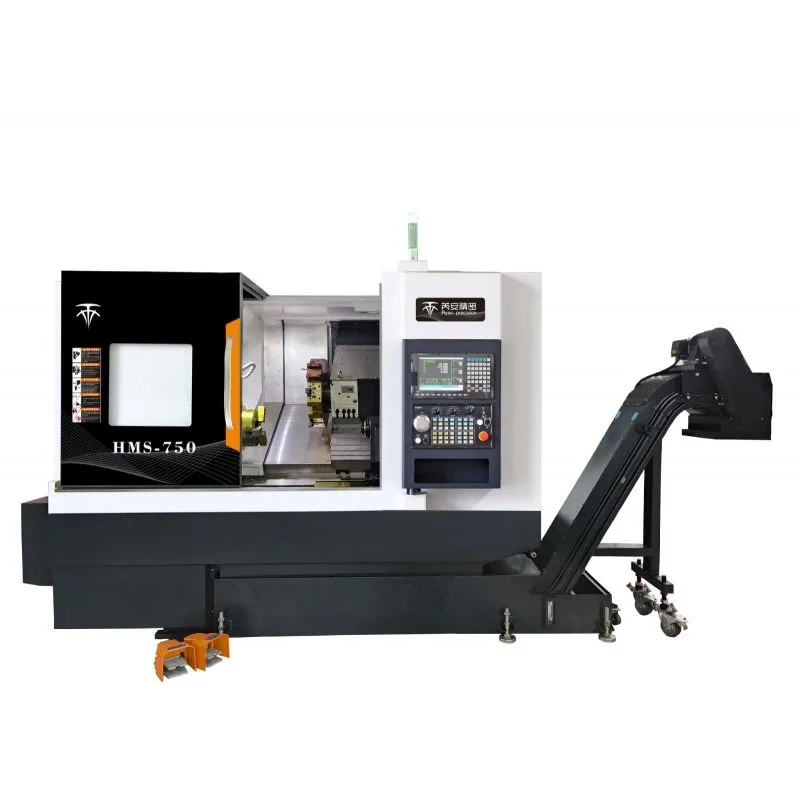
HMS-750 long-bed turret lathe
| Item | Value |
|---|---|
| Maximum turning length | 740 mm |
| Maximum bar diameter | Φ52 mm |
| Spindle bore | Φ65 mm |
| Maximum spindle speed | 4,000 rpm |
| Spindle power / torque | 11 kW / 72 N·m |
| Tailstock | Z-carried, 700 mm rail travel |
| Positioning / repeat | ±0.005 / ±0.003 mm |
Q1: HMS-750 turns 740 mm — what if the part is longer?
A: 740 mm is the guideway and travel limit. Parts of 750–900 mm can be turned in stages with a centre, but concentricity then depends on fixturing; for regular long work select a longer bed or move the operation to a supported setup.
Q2: How should Φ52 bar be loaded?
A: Φ65 mm bore with Φ52 mm rated bar capacity means a bar feeder runs the stock straight through and removes sawing and a second clamping. Bars above Φ52 mm must be chuck-loaded, which has to be settled before quoting.
Q3: When is the tailstock mandatory?
A: Above 4:1 length-to-diameter. The tailstock is Z-carried with 700 mm rail travel, MT5 taper, Φ80 mm sleeve and 80 mm stroke. Short stiff parts can run without it and leave the Z travel to the turret.
Q4: HMS-750 has no live tools — how are side holes made?
A: Either after turning on a machining centre, or by selecting HMS-750M / HMS-750MY. Forcing milling onto a turning-only turret lathe adds a setup and lengthens the tolerance chain.
Q5: What can 11 kW / 72 N·m cut?
A: Routine roughing and semi-finishing of carbon and alloy steel; stainless and hardened stock run with reduced depth of cut. It is not a first-cut machine for heavy castings or forgings.
Q6: How is accuracy verified?
A: ±0.005 mm positioning and ±0.003 mm repeat positioning, laser-checked per machine with the record shipped. C-axis rotation accuracy follows the individual machine's record.
Q7: What does the 4,500 kg frame actually do?
A: Mass is damping. On long shafts the cutting force acts on an overhanging section; a light frame shows chatter and deflection. A 4,500 kg frame with hardened ground guideways holds surface finish.
Q8: Is X 270 / Z 800 mm enough?
A: Z 800 mm matches the 740 mm turning length and leaves room for turret indexing and tailstock clearance; X 270 mm covers normal OD and facing work within the Φ580 mm swing.
Q9: What should maintenance watch?
A: Guideway lubrication and covers, tailstock centre alignment to the spindle, turret indexing position, chuck clamping force and coolant concentration. Check lubrication every shift, align the tailstock monthly.
Q10: How does it differ from HMS-750M?
A: Same bed and travels; HMS-750M adds a live turret for milling, drilling and tapping. HMS-750 is turning only — the decision rests on whether milled features must finish in one clamping.
CK-6140 | CK-6150B | HMS-750 | QPR-36L | Swiss-type 125
Dongguan Ruian Precision Machinery Co., Ltd.
Tel: +86 13929438020
Email: Vince@ruiancnc.com
Address: 1/F, Building 7, No. 8 TianKeng Gaoxin Road, Hengli Town, Dongguan, Guangdong, China
Website: ruiancnc.cn
CK-6140 vs CK-6150B | HMS-750 at 740 mm | 125 vs 205 | Swiss-type vs gang-tool
Next:
None
Related News
- -HMS-750 in Service: 740 mm, Φ52 Bar and Tailstock, 10 Questions
2026-11-24 - -QPR-36L or HMS-750: How to Split the Work, 10 Selection Answers
2026-11-24 - -Swiss-Type 125 in Service: Bushing, Sub-Spindle, 10 Questions
2026-11-24 - -QPR-46L: 10 Questions on Φ46 Bar, 20×20 Tooling and Cycle Time
2026-11-23 - -VMC-850L, 1165 or 1380: 10 Questions on Picking a VMC
2026-11-23 - -HMS-550MY: 10 Questions on Y-Axis ±50 mm and Tailstock
2026-11-23 - -BMT45 vs BMT55 Live Tooling: 10 Questions Before You Order
2026-11-22 - -Turn-Mill Commissioning: 10 Questions from the Shop Floor
2026-11-22 - -CNC Lathe Quotation, Lead Time and Shipping: 10 Buyer Questions
2026-11-22 - -What Are the Benefits of Turn-Mill Machining?
2024-05-15
