


HMS-750 at 740 mm: Which Parts Fit, 10 Answers on Φ52 Bar Work
Short answer: HMS-750 is built for mid-length parts finished on one machine. With 740 mm turning length, Φ52 mm bar capacity, 11 kW / 72 N·m and a tailstock, it earns its price on 300–700 mm cylinders, shafts and rollers — and is the wrong purchase for small fast-cycle parts or any job needing milling.
The question we hear most is whether to buy 740 mm or 550 mm, turret or turn-mill. Ten answers below set the boundary; all figures come from the product specification table.
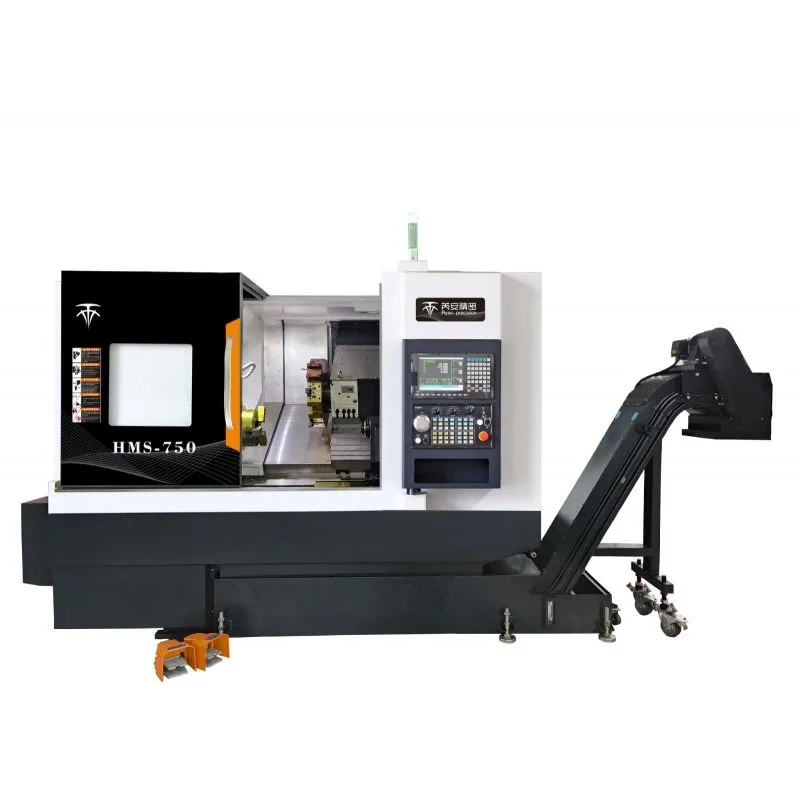
HMS-750 long-bed turret lathe
HMS-750 specifications at a glance
| Item | Value |
|---|---|
| Swing over bed | Φ580 mm |
| Maximum turning length | 740 mm |
| Maximum bar diameter | Φ52 mm |
| Spindle nose / bore | A2-6 / Φ65 mm |
| Maximum spindle speed | 4,000 rpm |
| Spindle motor power / torque | 11 kW / 72 N·m |
| X / Z travel | 270 / 800 mm |
| Tailstock | Z-carried, 700 mm rail travel |
| Sleeve taper / diameter / stroke | MT5 / Φ80 mm / 80 mm |
| Machine weight (approx.) | 4,500 kg |
What 740 mm of turning length actually covers
740 mm is long enough to be useful and short enough not to waste floor space. Cylinders, drive shafts, rollers, agitator shafts and screw blanks typically measure 300–700 mm, so one clamping completes the OD, the faces, the chamfers and the grooves without a second machine.
If the order book sits under 200 mm, you are buying guideway you will never use. Above 800 mm, forcing the part onto a 740 mm bed means picking up the cut mid-shaft, and concentricity suffers.
Φ52 bar through a Φ65 bore saves the blanking operation
A Φ65 mm bore with Φ52 mm rated bar capacity means Φ50-class bar stock feeds straight through the spindle. A bar feeder then runs continuously, and you skip sawing, a second clamping and the concentricity correction that follows.
Anything above Φ52 mm has to be chuck-loaded or moved to a larger bore, and that has to be settled before the quotation, not after.
What 11 kW / 72 N·m can and cannot cut
72 N·m covers routine roughing and semi-finishing of carbon and alloy steel at Φ50-class bar diameters; stainless and hardened stock run with reduced depth of cut. It is not a first-cut machine for heavy castings or forged blanks — that work needs a bigger torque class.
The tailstock is why long shafts need no re-alignment
The tailstock is carried on the Z axis with 700 mm rail travel, an MT5 taper, Φ80 mm sleeve and 80 mm stroke. Above 4:1 length-to-diameter, supporting the free end holds size and taper; turning unsupported, the tail end drifts.
No live tools: milling means stepping up
The live-tool row of the HMS-750 specification is blank — it is a turning-only turret lathe. Keyways, side holes or end-face eccentric holes in one clamping require HMS-750M or the Y-axis HMS-750MY; otherwise the part goes to a machining centre, and the tolerance chain grows by one setup.
4,500 kg buys finish quality on long parts
Mass is damping. On a long shaft the cutting force acts on an overhanging section, and a light frame shows it as chatter and deflection. A 4,500 kg frame with hardened, ground guideways and servo drives is what holds the surface finish on these mid-length parts.
Frequently Asked Questions
Q1: What are the headline numbers of HMS-750?
A: Φ580 mm swing over bed, 740 mm maximum turning length, Φ52 mm maximum bar, Φ65 mm spindle bore, 4,000 rpm, 11 kW / 72 N·m, about 4,500 kg.
Q2: Does a Φ65 mm bore take a Φ52 mm bar?
A: Yes. The 13 mm difference is clamping length and rotating clearance, and Φ52 mm is the published bar capacity of this model, so bar-fed work runs without a second setup.
Q3: Which parts fit 740 mm?
A: Hydraulic and pneumatic cylinders, drive shafts, rollers, long flanges and screw blanks in the 300–700 mm band. Above 740 mm you need a longer bed or a steady-rest sequence.
Q4: Is there a tailstock?
A: Yes: Z-axis carried, 700 mm rail travel, Morse 5 taper, Φ80 mm sleeve, 80 mm stroke. Shafts above 4:1 length-to-diameter should be centred.
Q5: Does HMS-750 have live tools?
A: No. The live-tool row in the specification is blank: HMS-750 is a turret lathe for turning only. For keyways, side holes or end-face eccentric holes in one clamping, step up to HMS-750M or HMS-750MY.
Q6: What torque does 11 kW / 72 N·m cover?
A: Routine roughing and semi-finishing of carbon and alloy steel at Φ50-class bar; stainless and hardened stock run with reduced depth of cut. It is not a first-cut machine for heavy castings or forgings.
Q7: What are the X and Z travels?
A: X 270 mm, Z 800 mm, on a machine of about 4,500 kg. The mass is what keeps long-shaft finishing free of chatter marks.
Q8: How is accuracy specified?
A: ±0.005 mm positioning and ±0.003 mm repeat positioning, laser-verified per machine. C-axis rotation accuracy follows the individual machine's record.
Q9: How does it split work with QPR-36L?
A: QPR-36L: 230 mm turning length, Φ36 bar, small fast-cycle parts. HMS-750: 740 mm, Φ52 bar, mid-length parts with several operations. Running both is a common pairing.
Related pages
CK-6140 flat-bed lathe | CK-6150B flat-bed lathe | HMS-750 long-bed turret lathe | Swiss-type 125 | Swiss-type 205
Dongguan Ruian Precision Machinery Co., Ltd.
Tel: +86 13929438020
Email: Vince@ruiancnc.com
Address: 1/F, Building 7, No. 8 TianKeng Gaoxin Road, Hengli Town, Dongguan, Guangdong, China
Website: ruiancnc.cn
Swiss-type vs gang-tool: how to choose | HMS-750 product page | CK-6150B product page | CK-6140 product page
Next:
None
Related News
- -HMS-750 at 740 mm: Which Parts Fit, 10 Answers on Φ52 Bar Work
2026-11-24 - -CK-6140 vs CK-6150B: Φ66 and Φ82 Spindle Bores in 10 Questions
2026-11-24 - -Swiss-Type 125 vs 205: Φ12 and Φ20 Bar Boundaries in 10 Answers
2026-11-24 - -Turn-Mill One Setup vs Lathe + Machining Center: Where Accuracy Breaks
2026-11-23 - -VMC-850L Acceptance: ±0.005 mm Positioning and 24T Tool Sequencing
2026-11-23 - -Gang-Tool Lathe Cycle Time: Why QPR-36L Wins on Small Parts
2026-11-23 - -Spindle Bore Φ56, Φ66 or Φ82: How Thick a Bar Can You Actually Run?
2026-11-22 - -HMS-550MYS vs HMS-550MY: Sub-Spindle or Tailstock?
2026-11-22 - -HMS-320MY Compact Turn-Mill: Which Parts Actually Fit?
2026-11-22 - -What Does a ±50 mm Y-Axis Cover? HMS-750MY Turn-Mill Machine Explained
2026-11-21
