


What Does a ±50 mm Y-Axis Cover? HMS-750MY Turn-Mill Machine Explained
Short answer: the HMS-750MY's ±50 mm Y axis, combined with a BMT55-12T live tooling turret, Ø420 mm max turning diameter, 710 mm turning length, Ø52 mm bar capacity and a Morse 5 tailstock, lets you machine off-centre holes, face side milling and radial slots in one setup. Beyond ±50 mm off-centre, or beyond 710 mm length, it is out of scope.
What problem does a Y axis actually solve?
On a plain turret lathe the tool sits on the centreline. Off-centre holes, side slots and features that are not on the axis need a second setup or a fixture. A Y axis lifts the tool off the centreline by up to 50 mm, folding part of a machining centre's capability into the lathe.
Typical coverage: off-centre oil holes on a flange face, radial slots on a shaft end, cross holes on a face, keyways that need side milling. The test is simple — is the feature centre within 50 mm of the turning centre? Beyond that, forcing the cut only produces tool deflection and oversize holes.

HMS-750MY turn-mill machine
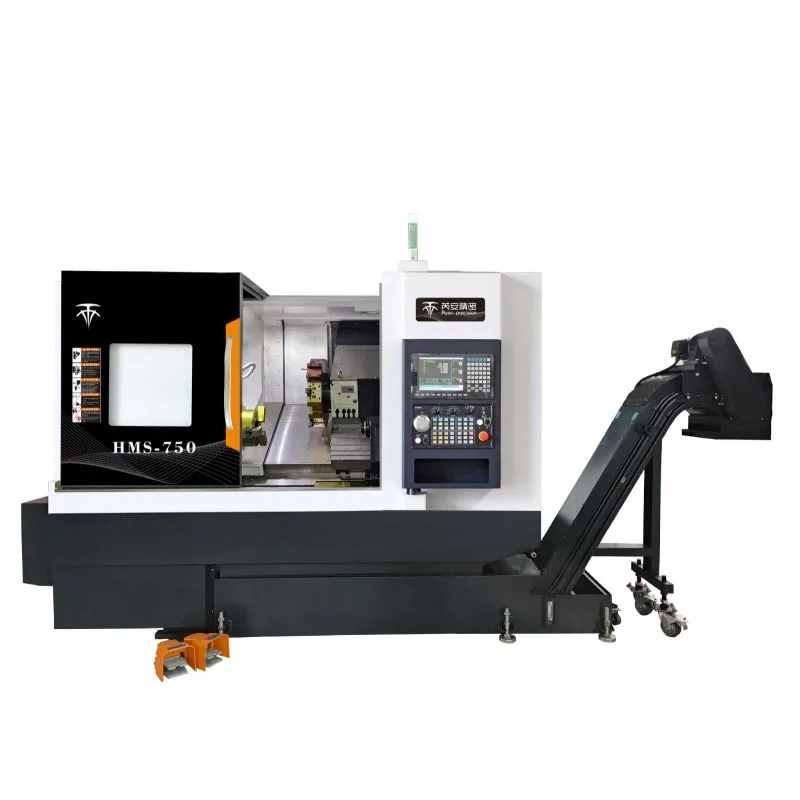
HMS-750 turret lathe
HMS-750MY vs HMS-750 specification table
| Item | HMS-750MY | HMS-750 |
|---|---|---|
| Swing over bed | Ø580 mm | Ø580 mm |
| Max. turning diameter | Ø420 mm | Ø450 mm |
| Diameter over carriage | Ø370 mm | Ø370 mm |
| Max. turning length | 710 mm | 740 mm |
| Bar capacity | Ø52 mm | Ø52 mm |
| Spindle nose / bore | A2-6 / Ø65 mm | A2-6 / Ø65 mm |
| Spindle speed | 4000 rpm | 4000 rpm |
| Spindle power / torque | 15 kW / 98 N·m | 11 kW / 72 N·m |
| X / Z travel | 260 / 800 mm | 260 / 800 mm |
| Y-axis travel | ±50 mm | none |
| Turret | BMT55-12T live tooling with Y axis | 12-station turret |
| Rapid traverse | 24 m/min | 24 m/min |
| Guideways | 45 mm ball linear guides | 45 mm ball linear guides |
| Tailstock | Morse 5, Ø80 mm quill, 80 mm stroke | Morse 5, Ø80 mm quill |
| Tailstock rail | 700 mm | 700 mm |
| Net weight | 4800 kg | 4500 kg |
Why keep a tailstock if you have a Y axis?
The Y axis handles offset; the tailstock handles length. On 710 mm long shafts with a large length-to-diameter ratio, the workpiece overhangs and vibrates; a Morse 5 tailstock with Ø80 mm quill, 80 mm stroke and 700 mm rail holds it. They are not alternatives — they solve different problems.
How should you sequence the setup?
Face and turn the OD first to establish the datum, then bring the tailstock in, then cut off-centre holes and side mill. Doing milling first lets the subsequent turning distort features already cut. On the turret, axial holders run the off-centre drills and radial holders run side milling; check holder runout before switching.
FAQ
Q1: What can a ±50 mm Y axis machine?
A: Off-centre holes, face side milling, radial slots and cross holes within 50 mm of the centreline.
Q2: How does it differ from the HMS-750?
A: ±50 mm Y axis, BMT55-12T live tooling, 15 kW/98 N·m versus a 12-station turret with 11 kW/72 N·m and no Y axis.
Q3: Is a tailstock still needed?
A: For long shafts, yes — Morse 5, Ø80 mm quill, 80 mm stroke, 700 mm rail.
Q4: Is Ø65 mm bore enough for Ø52 mm bar?
A: Yes, with an 8-inch collet there is margin for clamping and feeding.
Q5: What is the maximum turning length?
A: 710 mm; max turning diameter Ø420 mm.
Q6: Which work is not suitable?
A: Parts beyond Ø420 mm or 710 mm, or work needing simultaneous front and back machining.
Contact us
Phone: +86 13929438020
Email: Vince@ruiancnc.com
Address: 1F, Building 7, No. 8 Tiankeng Gaoxin Road, Hengli Town, Dongguan, China
Website: ruiancnc.cn
Email: Vince@ruiancnc.com
Address: 1F, Building 7, No. 8 Tiankeng Gaoxin Road, Hengli Town, Dongguan, China
Website: ruiancnc.cn
Product pages: HMS-750MY turn-mill machine · HMS-750 turret lathe · Turn-mill category · VMC-850L machining center
Further reading
- HMS-750MY turn-mill machine specifications
- HMS-750 CNC turret lathe
- QPR-46L gang-tool lathe
- VMC-850L vertical machining center
Related articles
Next:
None
Related News
- -What Does a ±50 mm Y-Axis Cover? HMS-750MY Turn-Mill Machine Explained
2026-11-21 - -Where Does the VMC-850L Get Its Rigidity? BT40, 35 N·m and Roller Guideways Explained
2026-11-21 - -QPR-46L vs QPR-36L: How to Choose a Gang-Tool Lathe (Bar Ø46 or Ø36)
2026-11-21 - -T600-5 5-Axis Machining Center: 10 Questions Buyers Ask Before Ordering
2026-11-20 - -How to Choose a 5-Axis Machining Center for Complex Parts
2026-11-19 - -CNC Turn-Mill Machine Manufacturer for Europe, Russia and South America
2026-11-18 - -HSK-A63 versus BT40: fixing the wrong comparison first, then what dual contact is actually worth
2026-11-16 - -How to Choose a 5-Axis Machining Center: T700-3+2 vs TW-400, Parameter by Parameter
2026-11-12 - -What jobs suit a CK-6150B flat-bed CNC lathe?
2026-11-03 - -Drilling-tapping center or machining center? How to choose
2026-11-03
