


HMS-550MYS vs HMS-550MY: Sub-Spindle or Tailstock?
Bottom line: HMS-550MYS and HMS-550MY are one platform with one decision to make — sub-spindle or tailstock. Bed, spindle, turret and Y axis are identical. If the part is machined on both ends and coaxiality is inspected, take the MYS. If the part is long and the work is on one end, take the MY.
Buyers often assume these are a large and a small machine. They are not. Both share Φ580 mm bed swing, A2-6 spindle with Φ65 mm bore at 4000 rpm, 8-inch chuck, Φ52 mm bar capacity, BMT55-12T turret with Y ±50 mm, and an 11 kW / 72 N·m spindle motor. The split is entirely in the second channel, and that decides the process plan.
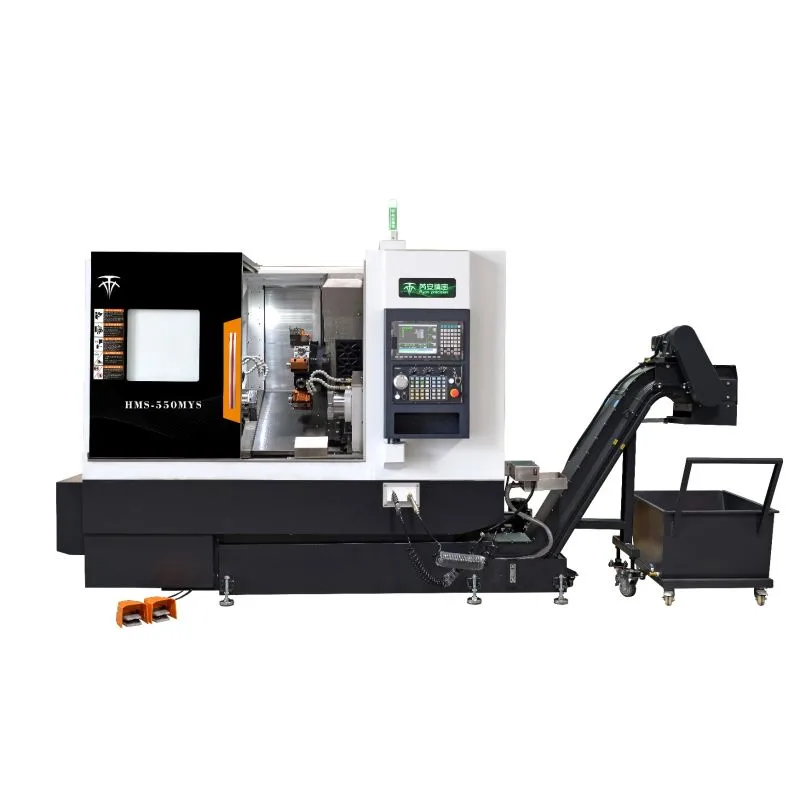
HMS-550MYS

HMS-550MY
What exactly is shared between the two?
Turning capacity does not need re-evaluating when you switch versions. Bed swing Φ580 mm, maximum turning diameter Φ410 mm on MYS and Φ420 mm on MY, turret envelope Φ370 mm on both. Spindle A2-6, bore Φ65 mm, 4000 rpm, 8-inch chuck, bar Φ52 mm. Turret BMT55-12T with 12 stations, Y ±50 mm, boring bar Φ40 mm, live tooling 2.3 kW / 11.0 N·m.
Travel differs because of the second channel: MYS runs X 260 / Z 800 / Y ±50 / Z2 400 mm, MY runs X 260 / Z 600 / Y ±50 mm. Linear guides are 45 size on both.
| Item | HMS-550MYS | HMS-550MY |
|---|---|---|
| Bed swing | Φ580 mm | Φ580 mm |
| Max. turning diameter | Φ410 mm | Φ420 mm |
| Turret max. turning diameter | Φ370 mm | Φ370 mm |
| Max. machining length | 435 mm | 510 mm |
| Bar capacity (main) | Φ52 mm | Φ52 mm |
| Bar capacity (sub) | Φ46 mm | none |
| Spindle | A2-6, Φ65 mm, 4000 rpm, 8-inch | A2-6, Φ65 mm, 4000 rpm, 8-inch |
| Second channel | Sub-spindle A2-5, Φ56 mm, 4000 rpm, 6-inch | Tailstock MT5, sleeve Φ80 mm, stroke 80 mm, rail 460 mm |
| Travel X / Z / Y / Z2 | 260 / 800 / ±50 / 400 mm | 260 / 600 / ±50 / — |
| Spindle gap | 40–440 mm | — |
| Spindle motor | 11 kW / 72 N·m | 11 kW / 72 N·m |
| Sub-spindle torque | 57 N·m | — |
| Footprint with conveyor | 3956 × 2018 × 2100 mm | 3956 × 2018 × 1920 mm |
| Weight | approx. 4500 kg | approx. 4300 kg |
How many operations does a sub-spindle actually remove?
One clamping, not one axis. Take a valve spool machined on both ends. The conventional route turns one end, unloads, re-chucks, indicates the part and turns the other end; coaxiality depends on the chuck and the operator. On the MYS the main spindle cuts the front, the sub-spindle picks up the part anywhere in the 40–440 mm window, the main chuck opens and both spindles rotate synchronised while the back end is finished in position.
The saving is not only handling time. It is the removal of the re-alignment variable. Sub-spindle A2-5, bore Φ56 mm, 4000 rpm, 6-inch chuck, 57 N·m, handles bar up to Φ46 mm. On a batch where coaxiality is inspected, that is usually the difference between passing and reworking.
Where does the tailstock version win?
The MY tailstock is MT5, sleeve Φ80 mm, stroke 80 mm, rail travel 460 mm. It supports the far end of a long shaft and suppresses deflection and chatter. Without a sub-spindle in the way, usable Z length reaches 510 mm, 75 mm more than the MYS, so the same part has more clamping room and simpler fixturing.
If the order book is dominated by long shafts with single-end work, the MY is the cheaper answer: no sub-spindle, 200 kg lighter, about 1000 mm shorter in the body.
What does the 40–440 mm gap mean in practice?
It is the length window in which the sub-spindle can take over. Shorter than 40 mm and there is no room to clamp; longer than 440 mm and the sub-spindle cannot reach. List the lengths of parts that need both ends machined; the share inside 40–440 mm is the share of your capacity the MYS can absorb.
How much floor space do you actually need?
MYS is 3790 mm and MY is 2790 mm, but both are 3956 mm with the right chip conveyor. The conveyor direction sets the real footprint. Weight is 4500 kg against 4300 kg, close enough that normal workshop flooring is adequate for both; no separate heavy foundation is required.
One question decides it: does the part get flipped?
Flipped, and coaxiality is inspected → HMS-550MYS. Not flipped, but long and needs support at the far end → HMS-550MY. Both, at volume → start with MYS for the double-ended family and keep long shafts on an HMS-750. Anything above Φ52 mm bar or Φ410 mm turning leaves this pair entirely.
Specification pages: HMS-550MYS, HMS-550MY, HMS-750MYS, HMS-750.
Frequently asked questions
Q1: Are the HMS-550MYS and HMS-550MY the same machine?
A: Same platform, two versions. Both have Φ580 mm bed swing, A2-6 spindle with Φ65 mm bore at 4000 rpm, 8-inch chuck, Φ52 mm bar capacity, BMT55-12T turret with Y ±50 mm and an 11 kW / 72 N·m spindle motor. The difference is the second channel: a sub-spindle on MYS, a tailstock on MY.
Q2: Why is the maximum machining length shorter on the sub-spindle version?
A: The sub-spindle occupies Z-axis space. The specification gives 435 mm maximum machining length for MYS against 510 mm for MY, with a 40–440 mm gap between the two spindles. Long shafts are limited by that gap on MYS.
Q3: What does the 40–440 mm spindle gap actually limit?
A: It sets the window of part lengths that can be handed from main to sub-spindle. Below 40 mm there is not enough room to clamp; above 440 mm the sub-spindle cannot reach. Parts outside that window still need a second operation.
Q4: Which parts belong on the HMS-550MYS?
A: Parts with operations on both ends where coaxiality is a customer acceptance item: hydraulic valve spools, small steering shafts, double-sided flange parts. One clamping, both ends machined, no re-alignment.
Q5: Which parts belong on the HMS-550MY?
A: Longer parts with mostly single-end work: high length-to-diameter shafts, lead screws, tube parts. The MT5 tailstock (sleeve Φ80 mm, stroke 80 mm, rail 460 mm) supports the far end and the 510 mm length gives more clamping room.
Q6: How much floor space and weight differ?
A: MYS is 3790 mm long (3956 mm with right chip conveyor), 2018 mm wide, 2100 mm high, about 4500 kg. MY is 2790 mm long (3956 mm with conveyor), 2018 mm wide, 1920 mm high, about 4300 kg. Plan the layout on the 3956 mm conveyor dimension for both.
Q7: Y axis and live tooling are identical, so why do they feel different?
A: Because the number of setups differs. Both have Y ±50 mm and 2.3 kW / 11.0 N·m live tooling, so single-operation cutting power is the same. MYS removes a second clamping, which shows up in cycle time and repeatability rather than in spindle power.
Q8: If the order book mixes short and long parts, which one first?
A: Measure the length distribution first. If more than a third of the parts exceed 435 mm, take the MY. If coaxiality on double-ended parts is the acceptance criterion, take the MYS. Both sit inside Φ52 mm bar and Φ410–420 mm turning, so anything larger moves you to the HMS-750 series.
Dongguan Ruian Precision Machinery Co., Ltd.
Tel / WhatsApp: +86 13929438020 (Vince) Email: Vince@ruiancnc.com
Address: Floor 1, Building 7, No. 8 Tiankeng Gaoxin Road, Hengli Town, Dongguan, Guangdong, China
Website: ruiancnc.cn
Further reading
Next:
None
Related News
- -Spindle Bore Φ56, Φ66 or Φ82: How Thick a Bar Can You Actually Run?
2026-11-22 - -HMS-550MYS vs HMS-550MY: Sub-Spindle or Tailstock?
2026-11-22 - -HMS-320MY Compact Turn-Mill: Which Parts Actually Fit?
2026-11-22 - -What Does a ±50 mm Y-Axis Cover? HMS-750MY Turn-Mill Machine Explained
2026-11-21 - -Where Does the VMC-850L Get Its Rigidity? BT40, 35 N·m and Roller Guideways Explained
2026-11-21 - -QPR-46L vs QPR-36L: How to Choose a Gang-Tool Lathe (Bar Ø46 or Ø36)
2026-11-21 - -T600-5 5-Axis Machining Center: 10 Questions Buyers Ask Before Ordering
2026-11-20 - -How to Choose a 5-Axis Machining Center for Complex Parts
2026-11-19 - -CNC Turn-Mill Machine Manufacturer for Europe, Russia and South America
2026-11-18 - -HSK-A63 versus BT40: fixing the wrong comparison first, then what dual contact is actually worth
2026-11-16
