


QPR-36L Gang-Tool Lathe: 10 Questions on Φ36 Bar and 230 mm
QPR-36L is limited by Φ36 mm bar, 230 mm turning length and Φ400 mm maximum turning diameter. It puts a gang-tool layout, 5000 rpm and 5.5 kW / 28 N·m on small-part batch work; beyond any of the three, change the model.
QPR-36L is a small high-speed gang-tool lathe for small shafts, pipe fittings, valve spools, fasteners, short flanges and end caps. It has no driven tools; drawings with milling or off-centre holes need an M-series machine.
The ten answers below follow the original parameters on the QPR-36L product page.
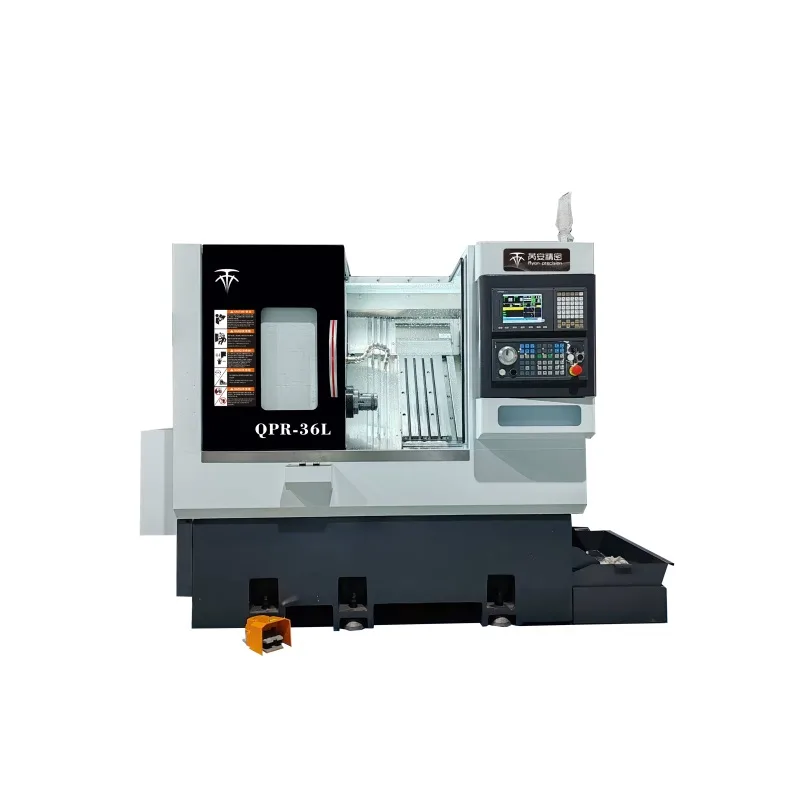
QPR-36L small high-speed gang-tool lathe
How large a part can QPR-36L machine?
Maximum turning diameter Φ400 mm, maximum turning length 230 mm, swing Φ400 mm. Do not force a shaft longer than 230 mm; length is the hard limit.
| Item | Value |
|---|---|
| Max swing | Φ400 mm |
| Max turning diameter | Φ400 mm |
| Max turning length | 230 mm |
| Max bar | Φ36 mm |
| Spindle nose / bore | A2-4 / Φ45 mm |
| Max spindle speed | 5000 rpm |
| Spindle motor / torque | 5.5 kW / 28 N·m |
| X / Z travel | 650 / 230 mm |
| Guide | 25 mm roller |
| Tooling | Gang / 16×16 / Φ20 |
| Positioning / repeatability | ±0.005 / ±0.003 mm |
| Weight | 2200 kg |
Is Φ36 mm bar a hard limit?
The bar channel is Φ36 mm for continuous feeding. A chuck-only disc can reach Φ400 mm and is not limited by the bar channel. Near Φ36 mm, confirm feeder thrust and clamping repeatability.
How should the 12 stations be arranged?
Rough OD, finish OD and face tools first, ID and grooving in the middle, threading tool on its own station to avoid interference. One tool per station; heavy tools near the centre and with short overhang.
Can it mill without driven tools?
No. QPR-36L is a pure turning gang-tool lathe; milling, face drilling and off-centre holes are impossible. Use QPR-46M or another live-tool turret model.
What materials suit 5000 rpm / 5.5 kW?
Small-diameter carbon steel, alloy steel and stainless steel at high speed. 5.5 kW / 28 N·m covers normal rough and finish turning; stainless and hardened steel need lower depth of cut and more coolant.
How is accuracy accepted?
The page states ±0.005 mm positioning and ±0.003 mm repeatability. Check spindle face and radial runout with a dial indicator, verify with a laser interferometer, run a ballbar circle and cut a standard test piece.
How do I control chatter?
Keep tool overhang within 1.5 times the holder height, reduce speed by 10–15%, and use a chipbreaker insert. The 25 mm guide has limited stiffness; do not force heavy cuts.
What about size drift and clamping distortion?
Inspect every 50–100 parts and offset for insert wear. For thin-wall parts, reduce clamping force, increase clamping area, and separate rough and finish passes.
How does it differ from QPR-46L?
Φ36/230 mm → 36L; Φ46/270 mm → 46L. 46L has 7.5 kW / 35 N·m and a 30 mm guide; it is the choice for heavier cuts and larger parts.
How do I confirm price, lead time and voltage?
Send the drawing, bar diameter, batch, operations and target cycle time. Standard machines take 5–20 days; specials and feeders follow the order. State 380 V/50 Hz or 60 Hz for export.
Frequently Asked Questions
Q1: How large a part can QPR-36L machine?
A: Φ400 mm maximum turning diameter and 230 mm maximum turning length; a longer shaft cannot be forced.
Q2: Is Φ36 mm bar a hard limit?
A: The bar channel is Φ36 mm; a chuck-only disc can reach Φ400 mm and is not limited by the channel.
Q3: How should the 12 stations be arranged?
A: Rough OD, finish OD and face first, ID and grooving in the middle, threading on its own station, heavy tools near the centre.
Q4: Can it mill without driven tools?
A: No. It is a pure turning gang-tool lathe; milling and off-centre holes need QPR-46M or another live-tool model.
Q5: What materials suit 5000 rpm / 5.5 kW?
A: Small carbon, alloy and stainless bar; 5.5 kW / 28 N·m covers normal rough and finish turning, with lower cuts for stainless.
Q6: How is accuracy accepted?
A: Check positioning ±0.005 mm and repeatability ±0.003 mm with a dial indicator, laser interferometer, ballbar and test cut.
Q7: How do I control chatter?
A: Shorten overhang, reduce speed 10–15% and use a chipbreaker; the 25 mm guide is not for heavy cuts.
Q8: What about size drift and clamping distortion?
A: Inspect every 50–100 parts and offset; reduce clamping force and separate rough and finish for thin walls.
Q9: How does it differ from QPR-46L?
A: Φ36/230 mm is 36L; Φ46/270 mm is 46L with 7.5 kW / 35 N·m and a 30 mm guide.
Q10: How do I confirm price, lead time and voltage?
A: Send the drawing, bar, batch and cycle target; standard 5–20 days; state 380 V/50 Hz or 60 Hz.
Contact Us
Phone: +86 13929438020
Email: Vince@ruiancnc.com
Address: No. 8 Gaoxin Road, Tiankeng, Hengli, Dongguan, Building 7, 1st Floor
Website: ruiancnc.com
Further reading: QPR-36L product page; QPR-46L product page; QPR-46L vs QPR-36L; HMS-550MYS sub-spindle; Spindle bore Φ52/Φ66/Φ82; BMT55 vs VDI tool holders;
Next:
None
Related News
- -HMS-550MYS Sub-Spindle: 10 Questions on 435 mm, Φ46 and Y Axis
2026-11-28 - -QPR-36L Gang-Tool Lathe: 10 Questions on Φ36 Bar and 230 mm
2026-11-28 - -HMS-1000MY Large Part Turning: 10 Questions on Φ72 Bar and 950 mm
2026-11-28 - -VMC-850L Rigidity: BT40, 35 N·m and Roller Linear Guides in 10 Questions
2026-11-27 - -BMT Toolholder Installation and Maintenance: 10 Shop-Floor Questions
2026-11-27 - -HMS-320MY for Small Parts: Φ46 Bar, Y Axis and Live Tools in 10 Questions
2026-11-27 - -HMS-750 in Service: 740 mm, Φ52 Bar and Tailstock, 10 Questions
2026-11-24 - -QPR-36L or HMS-750: How to Split the Work, 10 Selection Answers
2026-11-24 - -Swiss-Type 125 in Service: Bushing, Sub-Spindle, 10 Questions
2026-11-24 - -QPR-46L: 10 Questions on Φ46 Bar, 20×20 Tooling and Cycle Time
2026-11-23
