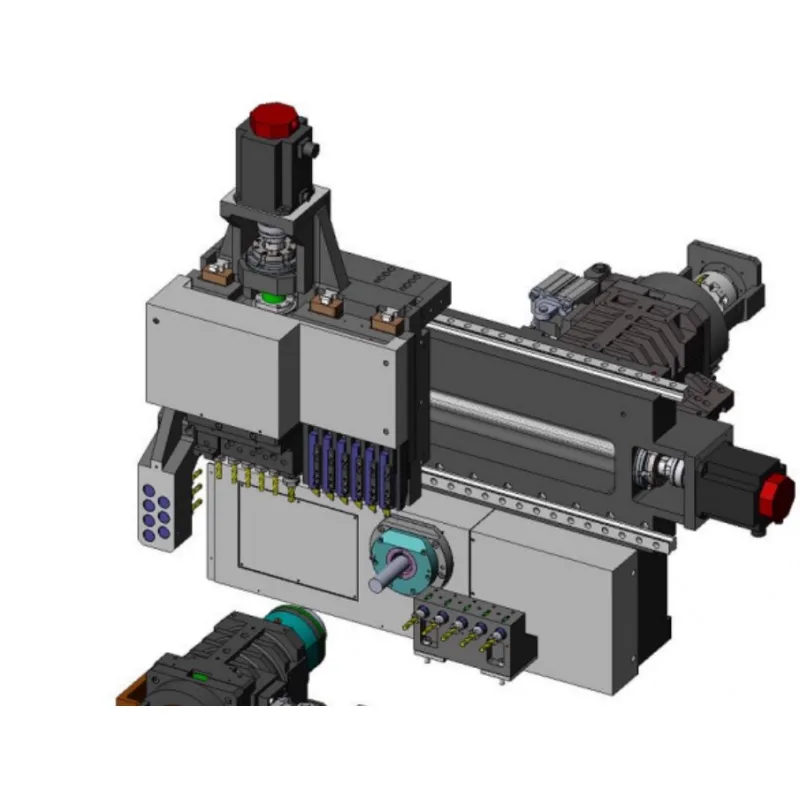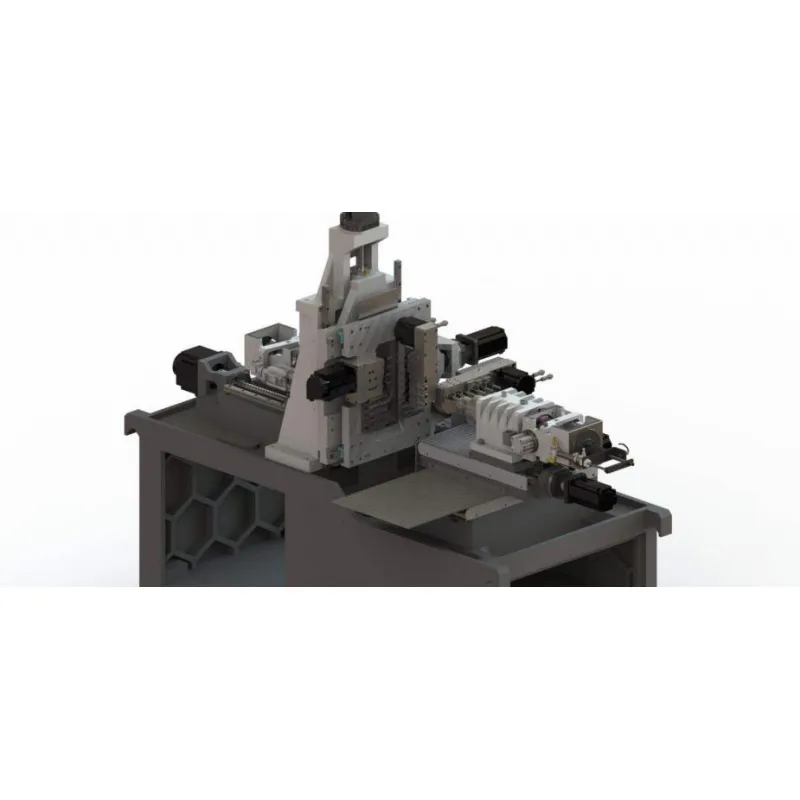

266 CNC Swiss-Type Lathe (Dual-Spindle)
- Model / Category:
266
- Product Overview:
Ruian 266 CNC Swiss-type lathe (dual-spindle sliding-headstock automatic lathe): max turning diameter Φ26 mm, spindle bore Φ28 mm, single feed stroke 105 mm, main and sub spindle up to 8000 rpm at 3.7 kW each, 9 gang stations with 16×16 shanks, 4×ER16 main side live and 4×ER16 sub live tools, for connectors, medical devices and electronic hardware up to Φ26 mm finished in one clamping.
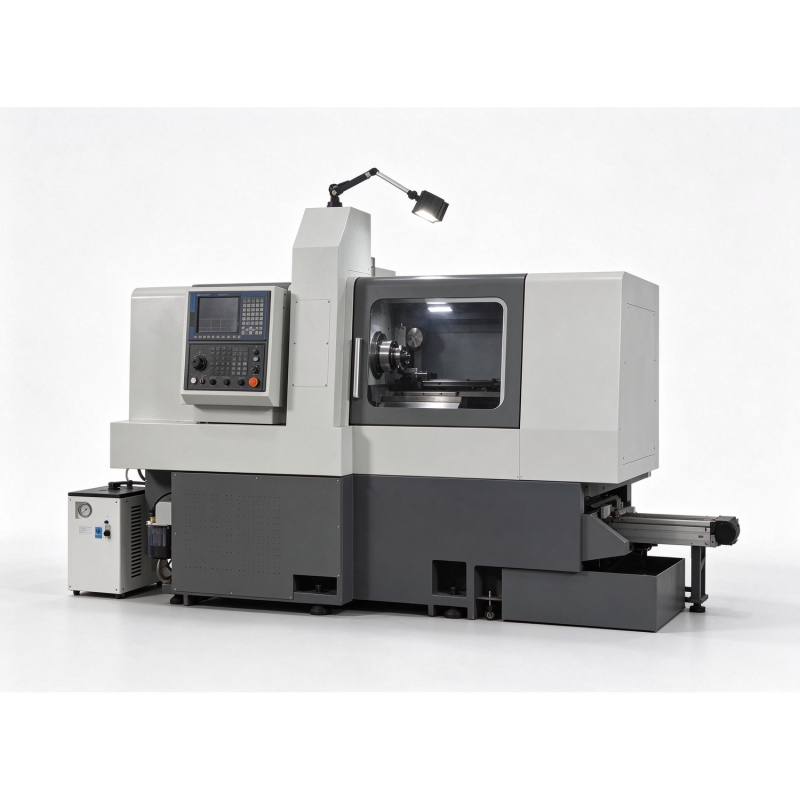
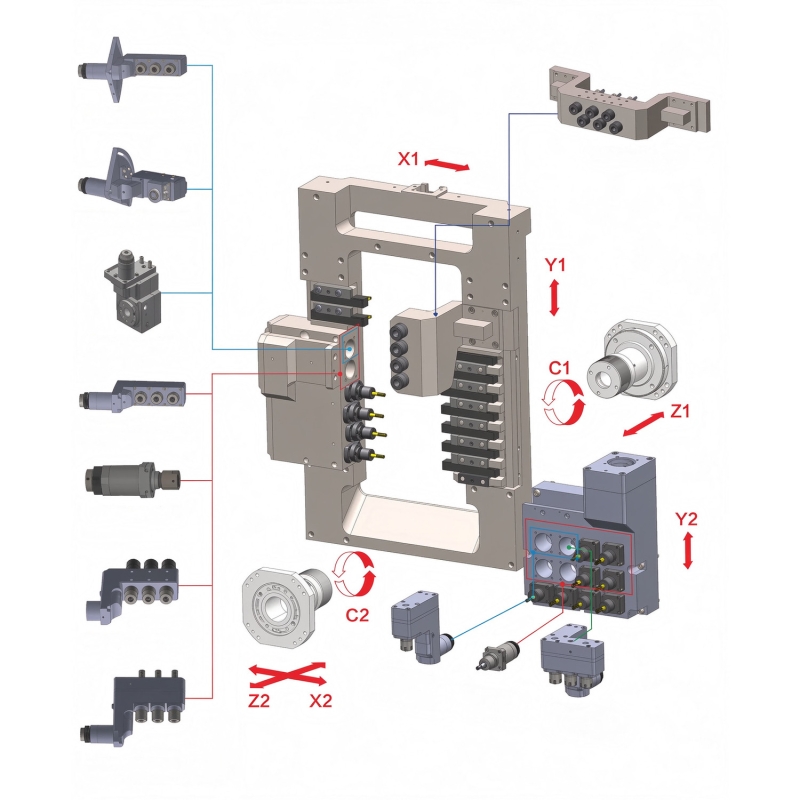


The 266 is a dual-spindle Swiss-type lathe, also called a sliding-headstock automatic lathe: max turning diameter Φ26 mm, spindle bore Φ28 mm, single feed stroke 105 mm, main and sub spindle up to 8000 rpm, 3.7 kW on each spindle motor, 9-station gang tooling with 16×16 tool shanks.
A Swiss-type machine works the other way round: the bar moves, the tools stay. The bar is gripped by the main spindle and fed forward through a synchronized guide bush, and all cutting happens right at the bush face, so cutting force always acts close to the clamping point. Long, slender parts do not deflect, and OD turning, facing, grooving, drilling, tapping and side milling are finished in one clamping before the sub spindle picks the part up for back working.
Φ26
Max turning diameter
105 mm
Single feed stroke
8000 rpm
Main / sub spindle
9 stations
Gang tooling
16×16
Tool shank
3500 kg
Machine weight
What parts does the 266 suit?
Small precision parts within Φ26 mm that need several faces machined in one clamping: connector pins and shells, electronic hardware, medical parts such as bone screws and catheter fittings, watch and optical components, automotive sensor housings and small shafts, pneumatic fittings.
These parts share the same profile: large batch, small unit size, accuracy carried by consistency. OD tolerance is commonly within ±0.01 mm, and position tolerance depends on single clamping. The Swiss layout keeps turning, drilling, tapping and milling at the guide bush, which removes the stack-up error of a second clamping.
Long slender shafts are where it wins: the synchronized guide bush supports the work right at the cut, so shafts below Φ10 mm and longer than 100 mm that deflect on a conventional lathe can be machined steadily here.
Parts above Φ26 mm are outside this size class; a larger Swiss-type or a turret lathe is the better choice.
Which operations are finished in one clamping, and how are tools arranged?
The 266 has two tool groups, main spindle side and sub spindle side. The main side works the front of the part; the sub side takes over after pick-off and works the back. Both can cut at the same time, and cycle time follows the longer side.
Nine gang stations carry 16×16 shanks for OD turning, facing, grooving and parting. Four fixed ER16 front stations drill and tap on the face, up to Φ12 drilling and M12 tapping.
Four ER16 live tools on the main side run up to 5000 rpm and cover Φ10 drilling, M10 tapping and a Φ40 slitting saw for side milling and slotting. The three-station front live block drives three tools at once for multi-hole face work.
On the sub side there are four fixed ER16 stations, four ER16 front live stations and two ER16 side live stations, so the back can be drilled, tapped (up to M8) and side milled. Plug-in live heads are available when more live stations are needed.
| Position | Station type | Qty | Capability |
|---|---|---|---|
| Main gang tools | 16×16 shank | 9 stations | OD turning, facing, grooving, parting |
| Main front fixed | ER16 | 4 stations | Drilling Φ12, tapping M12 |
| Main side live | ER16 | 4 stations (5000 rpm) | Drilling Φ10, tapping M10, saw Φ40 |
| Main front live (3-in-1) | ER16 | 3 stations | Multi-hole face work at once |
| Sub front fixed | ER16 | 4 stations | Back drilling and tapping |
| Sub front live | ER16 | 4 stations (5000 rpm) | Drilling Φ10, tapping M8 |
| Sub side live | ER16 | 2 stations | Back side milling and slotting |
| Optional plug-in live | ER16 | Main radial 2, main axial 2×3, sub axial 2 | Extra live heads for specific jobs |
Which components are used in the build?
The build is specified for continuous small-part production: CNC, servos and encoder from SYNTEC, main and sub spindles are Xiamen Shituo permanent-magnet synchronous motor spindles, screws and guides are HIWIN / PMI precision-ground grade, bearings are NSK / NACHI.
| Component | Brand / model | Note |
|---|---|---|
| CNC system | SYNTEC (Taiwan) | 220TB |
| Main / sub spindle | Xiamen Shituo | Permanent-magnet synchronous motor spindle, 3.7 kW |
| Servo motors / drives | SYNTEC | X1/Z1/Y1/X2/Z2/Y2, 1 kW each |
| Main side live servo | Yaskawa (Japan) | 1.4 kW |
| Ball screws | HIWIN / PMI | Precision-ground grade |
| Linear guides | HIWIN / PMI | Precision-ground grade |
| Pneumatics | AirTAC | — |
| Cooling | Korean system | — |
| Lubrication | Taiwan system | — |
| Inverter | SYNTEC | — |
| Encoder | SYNTEC | Resolution 2048 |
| Electrical components | Omron / Jiuchuan | — |
| Bearings | NSK / NACHI | — |
What comes with the machine and what does the quote cover?
Each machine is quoted with one automatic bar feeder and the auxiliary package: RAY326-2.5M oil-film bar feeder (Taiwan, 2.5 m rack), 100 bar six-circuit high-pressure oil pump, electrostatic oil mist collector and chain-type chip conveyor.
The price includes tax, inland freight, installation, commissioning and training, with a one-year warranty on the whole machine.
The oil-film feeder pushes the bar through an oil film, so the bar surface is not marked and feed position stays stable, which suits continuous precision small-part production. The six-circuit high-pressure pump supplies tool-through coolant and collet clamping, and the mist collector handles the oil mist generated in cutting.
How do you choose between the 266 and the 206?
Start with bar diameter: for work within Φ20 mm and a compact footprint, the 206 is enough and costs less; for bars close to Φ26 mm, or when more live stations and stronger shank rigidity are needed, take the 266.
Then look at the number of operations: the 266 has 9 gang stations and three live groups on the sub side, which suits parts with many operations and tight cycle times; the 206 has 5 gang stations and fits small parts concentrated on the front and back faces.
Both use the SYNTEC 220TB control, so programming and operation stay the same when you expand capacity.
| Item | 266 | 206 |
|---|---|---|
| Max turning diameter | Φ26 mm | Φ20 mm |
| Spindle bore | Φ28 mm | Φ22 mm |
| Single feed stroke | 105 mm (full-stroke guide bush) | 80 mm (140 mm optional) |
| Main / sub spindle speed | 8000 rpm | 8000 rpm |
| Main gang stations | 9 | 5 |
| Gang tool shank | 16×16 mm | 12×12 mm |
| Main front fixed stations | 4×ER16 | 4×ER11 |
| Main side live | 4×ER16 | ER11×2 + ER16×2 (4 stations) |
| Sub stations | 4×ER16 fixed, 4×ER16 front live, 2×ER16 side live | 3×ER11 fixed, 3 front mill + 3 side mill |
| Main / sub spindle motor | 3.7 / 3.7 kW | 2.2 / 2.2 kW |
| Rapid traverse | 25 m/min (Y2 20) | 25 m/min |
| Dimensions | 2700×1500×2000 mm | 2100×1100×1700 mm |
| Machine weight | 3500 kg | 2500 kg |
| Machine power | 17 kW | 12 kW |
| CNC system | SYNTEC 220TB | SYNTEC 220TB |
What are the specifications of the 266?
The table follows the machine configuration sheet; items not listed are subject to the technical file supplied with the machine.
| Item | Unit | Value |
|---|---|---|
| Single feed stroke (main spindle) | mm | 105 (full-stroke guide bush, standard) |
| Max speed (main / sub spindle) | rpm | 8000 |
| Max turning diameter (main / sub) | mm | Φ26 |
| Min indexing increment (main / sub) | ° | Stepless |
| Spindle bore (main / sub) | mm | Φ28 |
| Main gang stations | ea | 9 |
| Gang tool shank | mm | 16×16 |
| Main fixed axial tools | ER | 4×ER16 |
| Max drilling diameter (main) | mm | Φ12 |
| Max tapping diameter (main) | mm | M12 |
| Main radial live tools | ER | 4×ER16 |
| Max speed of main radial live tools | rpm | 5000 |
| Max drilling diameter (main radial) | mm | Φ10 |
| Max tapping diameter (main radial) | mm | M10 |
| Max slitting saw diameter (main radial) | mm | 40 |
| Sub axial fixed tools | ER | 4×ER16 |
| Sub axial live tools | ER | 4×ER16 |
| Max speed of sub axial live tools | rpm | 5000 |
| Max drilling diameter (sub axial live) | mm | Φ10 |
| Max tapping diameter (sub axial live) | mm | M8 |
| Max drilling diameter (sub) | mm | Φ12 |
| Max tapping diameter (sub) | mm | M10 |
| Main / sub spindle motor | kW | 3.7 / 3.7 |
| Main radial live tool motor | kW | 1.4 |
| Sub axial live tool motor | kW | 1.0 |
| Servo axis motors | kW | X1/Z1/Y1/X2/Y2/Z2, 1 each |
| Lubrication pump motor | kW | 0.1 |
| Coolant pump motor | kW | 0.35 |
| Rapid traverse rate | m/min | 25 (X1/Y1/Z1/Z2/X2), 20 (Y2) |
| Coolant tank capacity | L | 260 |
| Lubrication tank capacity | L | 3 |
| Center height | mm | 1050 |
| Dimensions (L×W×H) | mm | 2700×1500×2000 |
| Machine weight | kg | 3500 |
| Machine power | kW | 17 |
| CNC control | — | SYNTEC 220TB |
How do you set cutting parameters for different materials?
Carbon and free-cutting steel (1215, SUM24L): 120–180 m/min, finishing depth of cut 0.3–0.8 mm, feed 0.05–0.12 mm/rev, form taps preferred for threading.
Stainless 303 / 304: 80–120 m/min, roughing depth 1–2 mm, finishing 0.2–0.4 mm, feed 0.05–0.1 mm/rev, high-pressure coolant mandatory to avoid built-up edge.
Brass and aluminium: 200–300 m/min, the spindle can run near the 8000 rpm limit; keep edges sharp and chips flowing, and avoid chlorine-containing coolant on aluminium.
Titanium and 17-4PH: 30–60 m/min, depth of cut 0.2–0.5 mm with lower feed; tool wear is fast, so shorten the tool change interval and raise coolant pressure.
These are reference ranges. Confirm them by trial cutting according to bar diameter, tool grade and surface requirement, and record the first-off parameters as the baseline for the batch.
What goes wrong most often on small parts, and how is it fixed?
Deflection on slender parts: guide bush clearance and radial tool force are the main causes. Match the bush to the measured bar diameter with 0.005–0.01 mm clearance, split roughing and finishing, and leave 0.1–0.2 mm for the finish pass.
Size drift: after continuous running the spindle and bed grow thermally and the part gets smaller. Warm up for 15–20 minutes until temperature is stable, and check and offset every 30–50 parts.
Chip wrapping: small-hole drilling and grooving are the worst. Use chip-breaker inserts, raise feed, apply high-pressure internal coolant, and switch deep holes to peck drilling.
Sub spindle pick-off misalignment: it directly affects back-working concentricity. Align the sub spindle to the main spindle with a test bar before pick-off, and set the pick-off collet force per part, lower for thin walls.
Bar surface marks: the feeder clamp and bush bore score the bar. Keep oil-film feed volume and cleanliness, clean the bush periodically, and turn the OD first when bar hardness varies.
How is accuracy assured and what is checked at acceptance?
Accuracy comes from three places: HIWIN / PMI precision-ground ball screws and linear guides, NSK / NACHI bearings, and Xiamen Shituo permanent-magnet synchronous motor spindles. Positioning accuracy ±0.005 mm, repeat positioning ±0.003 mm. Every machine is checked with a Renishaw laser interferometer and ballbar, and the records ship with the machine.
Acceptance starts with the face and radial runout of the main and sub spindle, then the clearance between guide bush and bar. Next, the laser interferometer checks positioning and repeat positioning on each axis, and the ballbar runs a circle to show backlash and circular interpolation.
Finally a trial run: 30–50 pieces of your typical part, checking OD, length, position tolerance and surface roughness; acceptance is signed once size is stable.
Keeping accuracy in daily use needs three habits: lubricate the bush and screws on schedule, finish-cut only after spindle temperature is stable, and re-set tools after a change or a crash. Skip these and the assembly accuracy will not last.
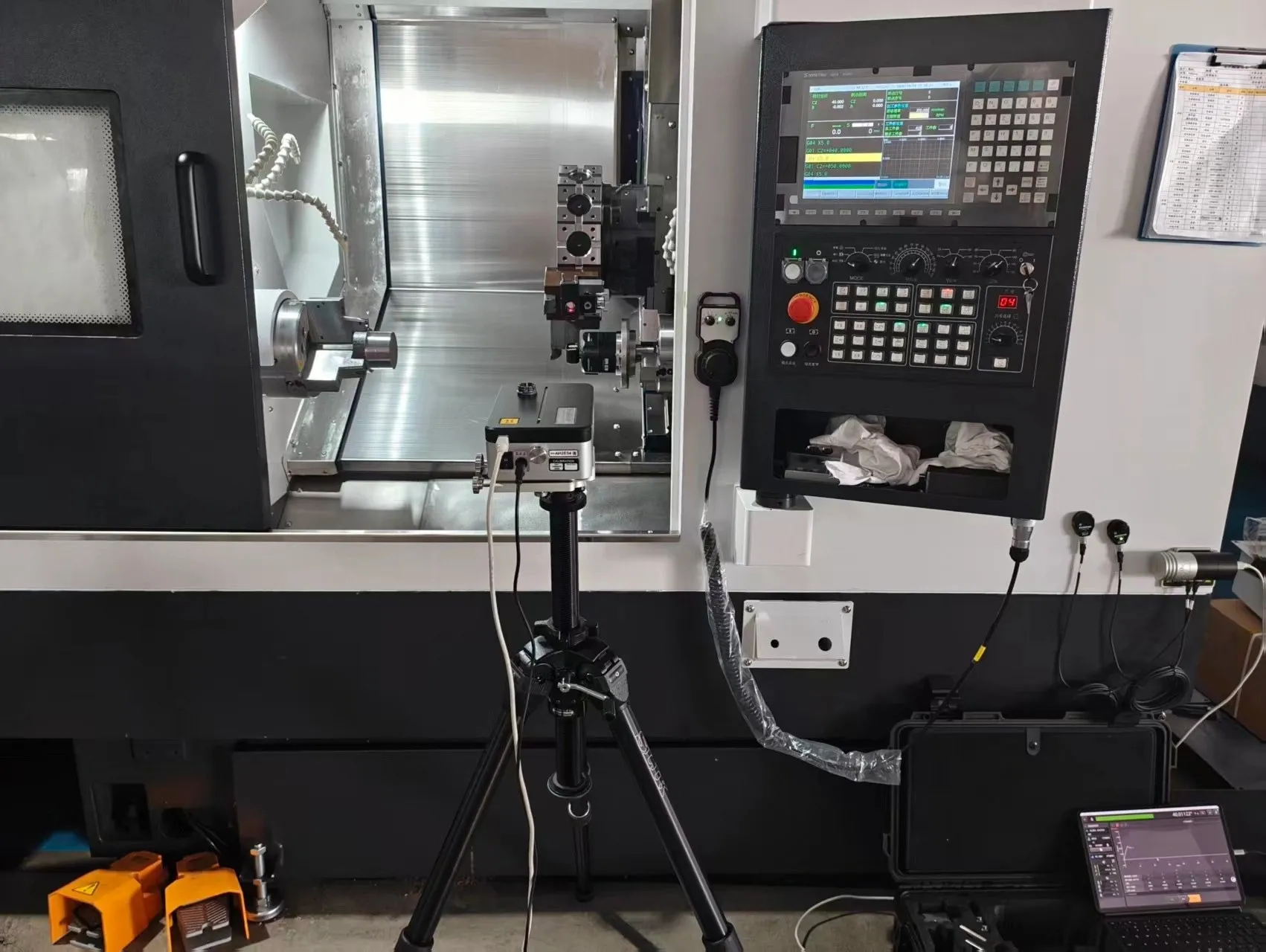
Laser interferometer: positioning and repeat positioning
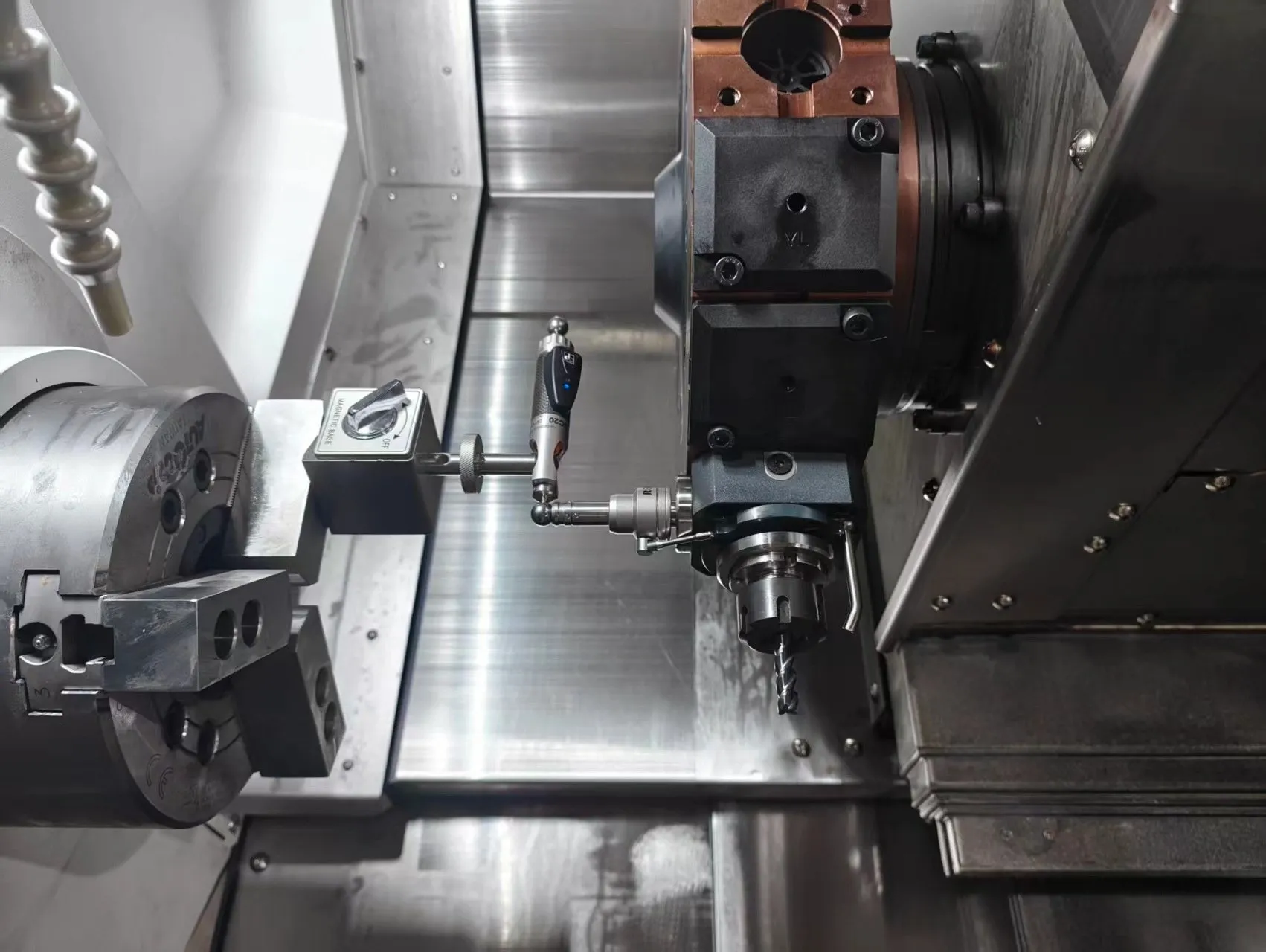
Ballbar: circular interpolation and backlash
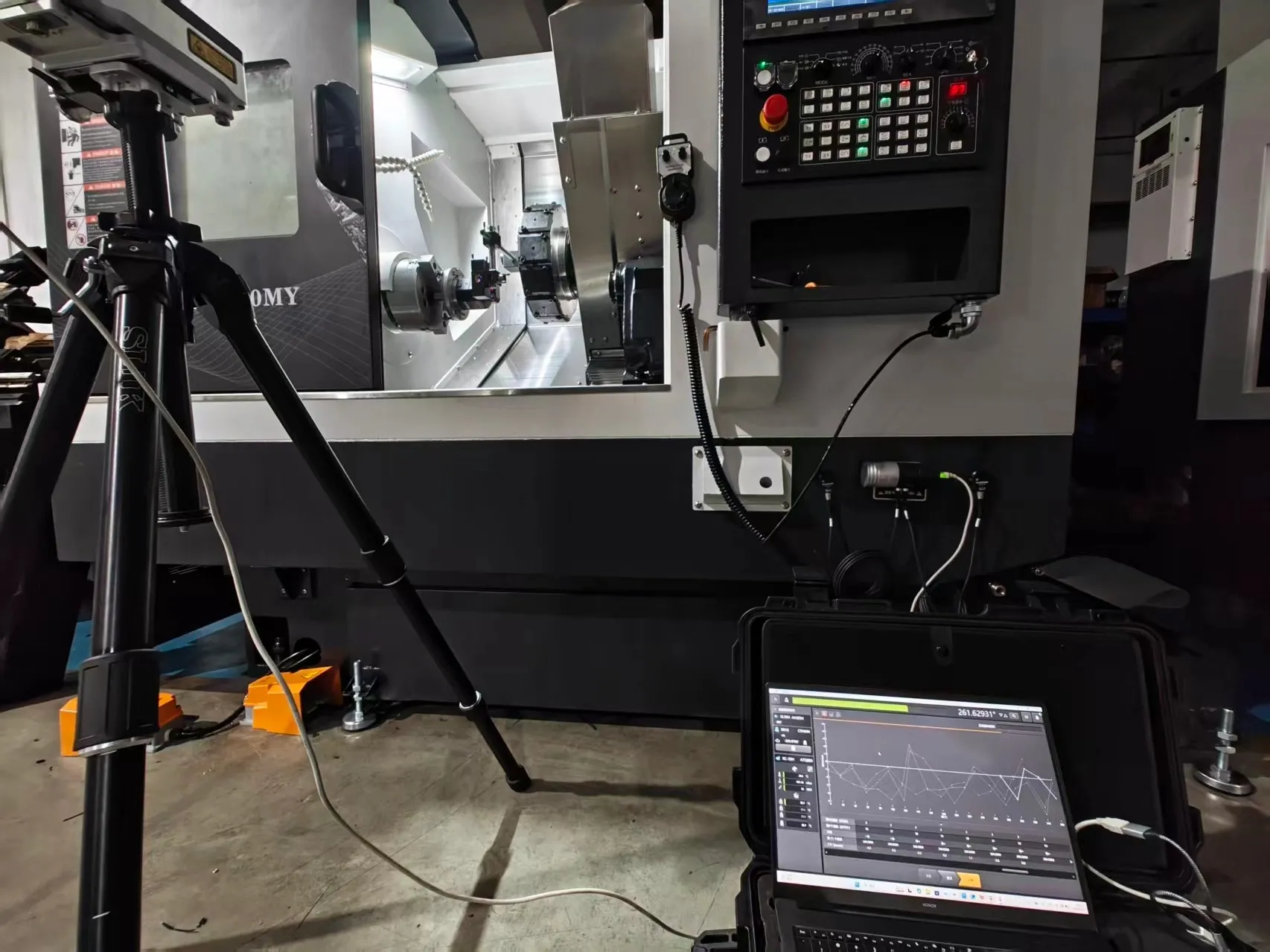 Tripod laser head and laptop: on-site data capture
Delivery, installation, commissioning and training
Standard models ship in 5–20 days; please ask for custom configurations. Before shipment the machine is run in, accuracy is re-checked, photos are archived, and it is crated with rust protection.
On site we handle installation and commissioning: leveling, power and air connection, bar feeder alignment, tool setting, dry run and trial cut, confirmed against your parts. Operator and maintenance training covers programming, tool setting, guide bush replacement, daily care and alarm handling.
After sales: 12-month warranty on the whole machine, 24-hour response within Guangdong and 48 hours outside the province; common wear parts are stocked, and programs and parameters are backed up and handed over.
Frequently asked questions
Q: What is the maximum part diameter on the 266?
A: Max turning diameter Φ26 mm, spindle bore Φ28 mm, so bars up to Φ26 mm.
Q: What are the main and sub spindle speeds?
A: Both run up to 8000 rpm with stepless indexing.
Q: How powerful are the spindle motors?
A: 3.7 kW on the main and 3.7 kW on the sub spindle; 1.4 kW on the main side live tools and 1.0 kW on the sub axial live tools.
Q: How long is one feed stroke?
A: 105 mm, with a full-stroke synchronized guide bush as standard.
Q: How many tools does the main spindle carry?
A: 9 gang stations with 16×16 shanks, 4 fixed ER16 front stations and 4 ER16 side live stations.
Q: What back-working operations can the sub spindle do?
A: 4 fixed ER16, 4 ER16 front live and 2 ER16 side live stations for drilling, tapping and side milling.
Q: What hole and thread sizes are possible?
A: Main spindle Φ12 drilling / M12 tapping, sub spindle Φ12 / M10; live tools Φ10 / M10 on the main side and Φ10 / M8 on the sub side.
Q: Which control and bar feeder are supplied?
A: SYNTEC 220TB control and a RAY326-2.5M oil-film bar feeder (Taiwan) with a 2.5 m rack.
Q: What accuracy can it hold?
A: Positioning ±0.005 mm and repeat positioning ±0.003 mm, checked on every machine with a Renishaw laser interferometer and ballbar.
Q: What about lead time and after-sales?
A: Standard models ship in 5–20 days; 12-month warranty with 24-hour response in Guangdong and 48 hours outside.
Talk to us about your parts
Dongguan Ruian Precision Machinery Co., Ltd.
Website: www.ruiancnc.cn
Phone / WhatsApp: +86 13929438020
Previous:
Model 386 Full-Function Swiss Lathe
Next:
None